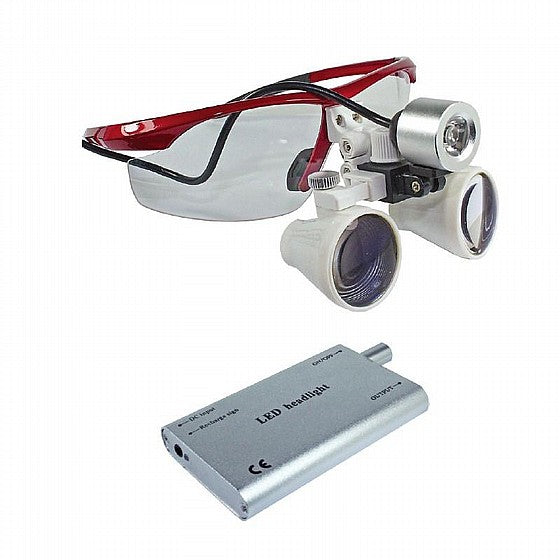
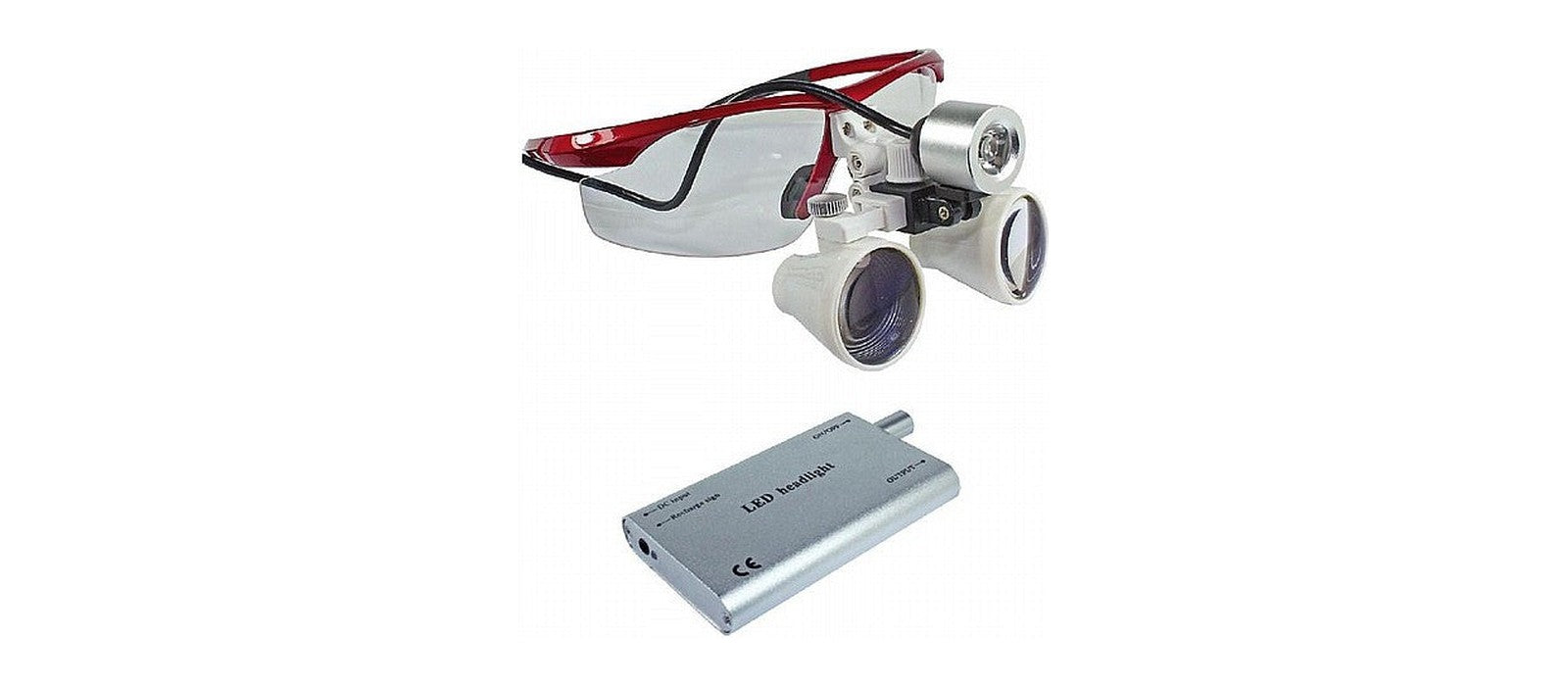
Magnification changes what a clinician can see, and light changes whether it can be seen clearly at depth. The two are bought together for a reason: a well-specified loupe with poor illumination still leaves the operator working in the shadow of their own hands.
Loupes are also a long-term purchase. The magnification and working distance chosen at the start shape how the operator sits for as long as the loupes are in use, and on most fixed through-the-lens systems neither is user-adjustable after manufacture. This guide covers the specifications worth settling before ordering.
What magnification changes at the chair
Magnification enlarges the apparent image, and it generally narrows the field of view at the same time. Every step up in power buys detail and costs surrounding view, so the right level is the lowest one that resolves the detail the work actually requires.
Magnification and field of view
At lower magnification the operator sees a wider section of the arch. At higher magnification the field generally covers a smaller section of it. For procedures that involve moving between quadrants, a narrower field means more head movement, not less.
Field of view is also a specification in its own right, quoted in degrees or millimeters at a stated working distance. Two loupes at the same power can present noticeably different fields, so it is worth comparing the figure rather than assuming power alone describes the view.
Depth of field
Depth of field is the range of distance that stays in focus without the operator moving. All else being equal it narrows as magnification rises, which is the practical reason high-power loupes are demanding: small shifts in posture drop the field out of focus.
For a first pair, a moderate power generally offers a wider field and a greater depth of field than a higher power, which can make the adjustment period easier.
Working distance is measured, not estimated
Working distance is the distance from the operator's eyes to the treatment field, and it is the specification most often guessed at. A loupe built for 450 mm used by someone whose natural working distance is 500 mm pulls the operator forward for every case.
How to measure it
Sit in the operating position that is actually used, with the patient at normal treatment height and the back upright. Have someone measure from the outer corner of the eye to the tooth being worked on. Measure it twice, in the positions used for both arches, and take the figure from the neutral working posture that is intended in daily use.
Height, arm length and chair setup all move this number, which is why a colleague's specification is not transferable.
What the wrong working distance costs
Loupes are frequently bought with posture in mind, and a working distance that does not match the operator works against that. If it is too short, the clinician has to move closer to bring the field into focus; if it is too long, the clinician has to move back or reposition the patient.
Because the correct figure differs from operator to operator, some models are offered in a choice of working distances so the pair can be specified to the individual. The Eighteeth Brilliance BP Surgical Loupes at 3x magnification are available at 400, 450 and 500 mm. Where one pair genuinely has to be shared between operators, an adjustable flip-up frame is the more practical route.

Choosing a magnification level
Most clinical work is covered by a narrow band of magnification. The procedure sets the starting point, and optical design, working distance, field of view and the operator's own experience all feed into the final choice.
| Magnification | Typical use | Field of view | Adaptation |
|---|---|---|---|
| 2.5x to 3x | General restorative, hygiene, examination, routine surgical procedures | Widest of the three; check the stated figure | Straightforward for a first pair |
| 3.5x | Restorative detail, margin work, implant prosthetics | Narrower than at lower power; check the stated figure | Requires stable posture |
| 4x and above | Endodontic access, fine surgical detail | Narrowest; varies with optical design and working distance | Demanding; shallower depth of field |
3x for general and hygiene work
For general restorative work, examination and hygiene, a moderate power keeps enough field to work efficiently while resolving margins and deposits that are difficult to see unaided. Compared with higher powers it also offers a wider field and a greater depth of field, which tends to shorten the adjustment period.
3.5x and above for detail work
Higher powers earn their place where the detail is genuinely small: crown margins, implant prosthetic components, endodontic access. The Eighteeth Brilliance Surgical Loupes at 3.5x are specified at 450 and 500 mm working distance, and the Eighteeth Brilliance 48° Pro Binocular Loupes are the wide-field option in the same range. As with any pair, the field of view should be compared as a stated figure at a stated working distance.

Fine component work is where magnification earns its place. Retrieving a fractured screw, covered in our guide to removing a broken implant screw or fractured fixture, is a procedure where improved visualization of a very small field is directly useful.
Illumination: the light matters as much as the optics
An overhead operatory light can be shadowed by the operator's own head and hands, and the deeper and more recessed the site, the more likely that becomes. This is why magnification and a mounted light are commonly specified together rather than separately.
Coaxial light and shadow control
A light mounted close to the viewing axis and aimed along it travels with the line of sight, so the illuminated area and the viewed area stay aligned as the head moves. The deeper the treatment site, whether a prepared cavity, a canal or a surgical site, the more that alignment matters. Frame mounting on its own does not guarantee it, so the position and aim of the light are worth checking.
Corded and wireless headlights
Corded units draw from a belt-mounted battery pack, which keeps the weight off the frame; wireless units place the battery on the frame and remove the cable entirely. Runtime is a function of battery capacity, output and the intensity setting rather than of the format itself, so it is compared per model.
The Eighteeth Wireless Z Surgical Headlight is the cable-free option; for clinicians who want optics and light specified together from the start, the Surgical Loupes 3.5x with LED Light combine both.

Intensity and color temperature
Adjustable intensity is generally more useful than maximum output, because it lets the clinician match the light to the procedure, the ambient lighting and the working distance. A single fixed output leaves no room for that.
Color temperature affects shade assessment. A light running cooler than the operatory lighting will shift how a shade appears, so shade selection is best carried out under a consistent, known light source rather than under the headlight.
Frame and mounting style
Through-the-lens loupes have the oculars set into the carrier lens, built to the operator's own working distance and interpupillary distance. They sit closer to the eye and generally offer a wider field, and those specifications are not user-adjustable after manufacture.
Flip-up loupes mount on a hinge in front of the lens, so they can be lifted out of the way and adjusted, and they transfer more readily between operators. For a first pair, or for equipment shared across a practice, the adjustability is often worth more than the optical advantage.
A selection checklist
Before ordering, settle the following:
- Working distance: measured in the actual operating posture, for both arches.
- Magnification: the lowest power that resolves the detail the work requires.
- Field of view: compared as a stated figure, not assumed from magnification.
- Mounting style: through-the-lens for a dedicated operator, flip-up for shared or first-time use.
- Illumination: mounted light, corded or wireless, with adjustable intensity.
- Runtime and output: stated battery runtime and illuminance at the working distance actually used.
- Weight: the combined weight of frame and light, since both sit on the nose and ears.
The full range is available in the Dental Loupes and Light collection, alongside the wider surgical instrument range and the surgical burs used with it.
Frequently Asked Questions
What magnification should I choose for dental loupes?
Choose the lowest magnification that resolves the detail the work requires, which for general restorative and hygiene work is usually in the 2.5x to 3x range. Higher powers such as 3.5x and above suit margin work, implant prosthetics and endodontic access, at the cost of a narrower field and a shallower depth of field.
How do I measure my working distance for loupes?
Sit in the posture actually used for treatment, with the patient at normal height and the back upright, and measure from the outer corner of the eye to the tooth being worked on. Measure for both arches and take the figure from the neutral posture intended for daily use, because height, arm length and chair setup all change it.
Do dental loupes need a separate light?
Not strictly, but a mounted light is what most clinicians add, because an overhead operatory light is easily shadowed by the operator's own head and hands over a recessed site. A light positioned close to the viewing axis stays aligned with the line of sight, which matters most in deep preparations, canals and surgical sites.
What is the difference between flip-up and through-the-lens loupes?
Through-the-lens loupes have the oculars built into the carrier lens at the operator's own working and interpupillary distance, sitting closer to the eye with a generally wider field, and are not user-adjustable afterwards. Flip-up loupes mount on a hinge, so they can be lifted away, adjusted, and shared between operators.
Are wireless dental headlights bright enough for clinical use?
Whether any headlight is bright enough depends on its stated output at the working distance actually used, together with spot size, runtime and intensity range, so those figures are what to compare rather than the wireless format itself. The practical trade-offs are battery runtime against a full clinical day and the added weight sitting on the frame rather than on a belt pack.