
Second stage surgery is the point where the soft tissue profile of the final restoration is first established. The healing component placed at that stage shapes the emergence contour that the definitive abutment and crown will later occupy.
Selecting it is a dimensional decision rather than a matter of preference. Three measurements govern the choice: the implant connection, the emergence profile diameter, and the gingival height.
What the healing component controls
A healing abutment is placed on top of the implant in place of a cover screw, sealing it from the oral cavity while the surrounding tissue heals. Its width determines how wide the tissue cuff forms, and its height determines how far it sits above the implant platform. Using it instead of leaving the implant fully submerged shortens the healing period, avoids a second surgical step to expose the implant, and lets the prosthetic phase begin directly once healing is complete.
That contour carries into the impression and into the final restoration. A component that does not match the site creates additional chair time later, so the interface is worth confirming before the component is ordered.
The three dimensions that define a healing abutment
Connection and platform
The connection has to match the implant, not simply the brand. dip dental™ lists healing components by connection and platform, so the internal hex range is separated into a regular platform at 2.42 mm and a narrow platform at 2.00 mm. The narrow platform is sized for Ø3.0 mm implants specifically and is not interchangeable with the regular platform range.
The conical connection range is listed the same way, with a regular platform at 4.3 to 5.0 mm and a narrow platform at 3.5 mm. How the two connection families behave at the restorative stage is covered in Conical Connection vs Internal Hex Implants.
Emergence profile diameter
The emergence profile diameter is the widest point of the component, where it meets the tissue. Across the internal hex range, profiles are listed at 3.5 mm, 3.8 mm, 4.5 mm, 4.6 mm, 5.5 mm and 6.3 mm.
Wider profiles are listed for molar sites, where the tissue is opened to a broader cuff. Narrower profiles suit anterior and premolar sites and cases with limited interdental space.
Gingival height
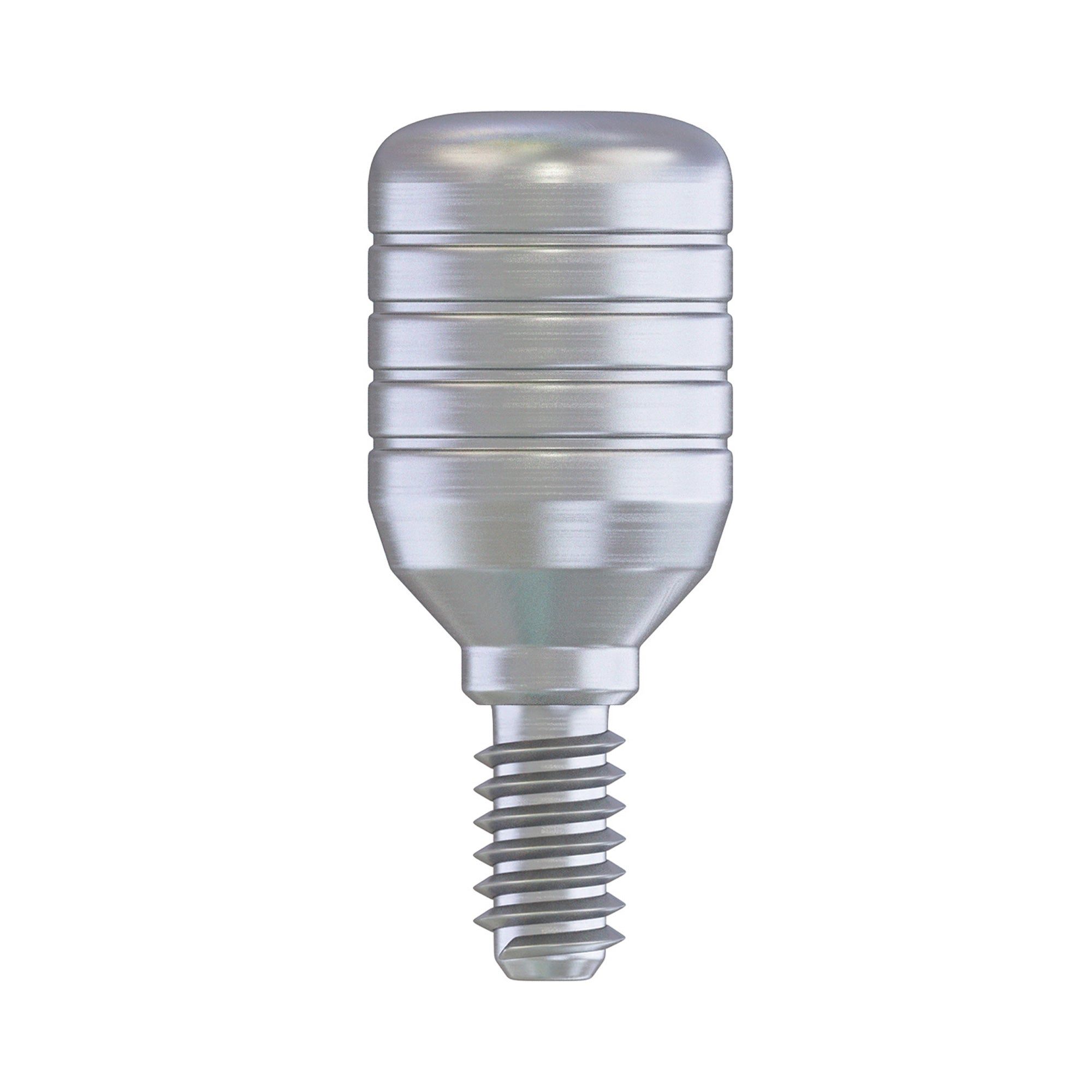
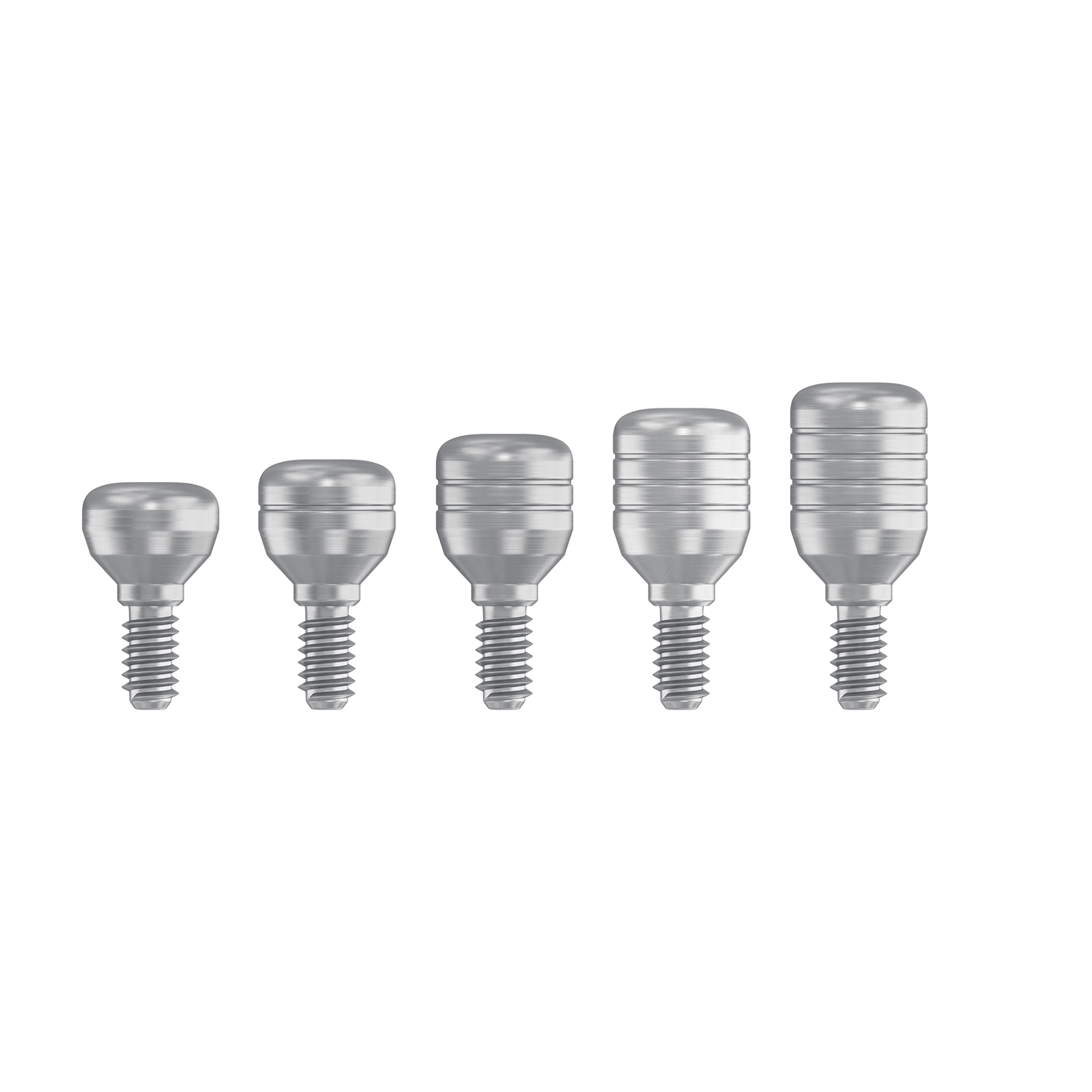
Gingival height is supplied as a variant on each product rather than as a separate item. Most of the internal hex range is listed in 2 mm, 3 mm and 4 mm, and the smooth body version in 3 mm, 4 mm and 5 mm. The standard and narrow platform bodies carry 1 mm ditch increments marked along the body itself, so the height already seated can be read visually and tactilely at chairside rather than only from the packaging.
The components listed as compatible with Neodent GM® Grand Morse extend further, in 1.5 mm, 2.5 mm, 3.5 mm, 4.5 mm and 5.5 mm. Tissue thickness at the site determines which height applies, and the measurement should be verified against the protocol for the implant in place.
Healing abutment options by connection
| Connection and platform | Emergence profile diameters listed | Gingival heights listed |
|---|---|---|
| Internal hex, regular platform 2.42 mm | 3.8, 4.5, 4.6, 5.5, 6.3 mm | 2, 3, 4 mm, and 3, 4, 5 mm on the smooth body version |
| Internal hex, narrow platform 2.00 mm (fits Ø3.0 mm implants) | 3.5 mm | 2, 3, 4 mm |
| Conical connection, regular platform 4.3 to 5.0 mm | 4.5 mm | 2, 3, 4 mm |
| Conical connection, narrow platform 3.5 mm | 4.5 mm | 2, 3, 4 mm |
The conical connection option is the DIP Concave Healing Cap for the conical connection regular platform, listed with a 4.5 mm profile.
Profile shapes in the internal hex range
Standard and slim body
The DIP Standard 4.6 mm healing cap is the general purpose option in the range, listed across a 2 to 6 mm height run in 1 mm ditch increments along the body.
The DIP Slim Body 3.8 mm healing cap is sized for thinner implants, the aesthetic zone and narrow interdental spaces, listed across a wider 2 to 7 mm height run. A wide profile at 5.5 mm and an extra wide profile at 6.3 mm are listed for broader molar sites.

Concave profiles
Concave versions are listed at 4.5 mm, 5.5 mm and 6.3 mm. The concave contour is designed to promote thicker mucosal tissue around the transgingival portion of the component, reducing how much metal shows through and increasing tissue transparency at the margin. dip dental™ lists this shape as suited to replacing the healing component directly with the permanent restoration, without a separate temporary step that could disturb the newly formed tissue.

Smooth body
The smooth body version is listed at 4.6 mm, with gingival heights of 3 mm, 4 mm and 5 mm. Its polished surface is intended to sit against soft tissue with less irritation than the ridged standard body, for a milder healing course. It extends the range one step taller than the standard profiles.
Narrow platform
The narrow platform healing cap is listed at a 3.5 mm profile for Ø3.0 mm implants on the 2.00 mm internal hex connection, in the same 1 mm ditch increment format as the standard platform. It is not a smaller variant of the regular platform range; the two connections are not interchangeable.
System-specific compatible healing abutments
Alongside the range organized by connection, dip dental™ lists healing components that are compatible with named implant systems. Each is listed against a specific platform.
| Compatible with | Platform as listed | Dimensions as listed |
|---|---|---|
| Neodent GM® Grand Morse | Grand Morse | 4.5 mm and 5.5 mm profiles, heights 1.5 to 5.5 mm |
| MegaGen AnyRidge® | AnyRidge | 4.2, 5.2, 6.2 and 7.2 mm profiles, heights 2.5 to 6.5 mm by diameter |
| Osstem® TS, Hiossen® ET and NeoBiotech® | Regular platform 2.5 mm and mini platform | 4.6 mm profile, heights 2, 3, 4, 5, 6 mm |
| Straumann® Bone Level | RC and NC | RC at 6 mm and 5 mm profiles, NC at 4.8 mm |
| MegaGen® Blue Diamond | NC | Single listed configuration |
| Dentium® | As listed | 6.3 mm profile, heights 4 mm and 5 mm |
The healing cap compatible with Osstem® TS and Hiossen® ET at the regular platform is listed as 100% compatible with the Osstem® TS / Hiossen® ET / NeoBiotech® Regular 2.5 mm platform across five gingival heights, machined on CNC equipment for tolerance, and a mini platform version is listed alongside it.

Multi-unit healing caps
Multi-unit restorations use a protective cap that seats on the abutment rather than on the implant, closing the screw access channel during healing rather than shaping an emergence profile at the implant itself.
dip dental™ lists these caps against the specific multi-unit connection they close. The cap for the M1.4 connection is listed as compatible with Nobel Biocare® and other MUA systems sharing that geometry. The cap for the M1.6 connection is listed as compatible with MIS® and other MUA systems sharing that geometry, at a Ø5 mm profile and 4.5 mm length. The cap for the M1.7 connection is listed as compatible with Paltop® and other MUA systems sharing that geometry. All three are milled from the same titanium as the multi-unit abutment itself and are seated with the same 1.25 mm hex driver used on the abutment, so no separate tooling is needed for the healing step.
The cap for the Multima Pro MUA M1.72 connection is listed at a 4.0 mm gingival height and is pink anodized rather than titanium colored, intended to read closer to natural gingiva during the healing period. It is listed as reusable and sterilizable according to clinical protocol, rather than single use.
A separate multi-unit healing abutment is listed as compatible with Neodent® GM, Osstem® TS and MegaGen®, because it seats on the multi-unit abutment rather than on the implant connection.
Verifying the interface before ordering
Confirm the following against the implant record before an order is placed:
- Implant system and the exact platform designation, not the brand alone
- Connection type and its diameter, for example internal hex at 2.42 mm or at 2.00 mm
- Emergence profile diameter required at the site
- Measured tissue thickness, which determines the gingival height variant
- Whether the case is restored at implant level or at multi-unit level
Where the implant identification is uncertain, verify it before ordering. What to check when selecting a compatible component is set out in OEM vs Compatible Dental Implant Components.
Digital cases add one step, because the scan body has to match the same platform once the healing component is removed. That sequence is described in the guide to scan bodies and digital workflows.
dip dental™ supplies components compatible with the major implant systems at a significantly more competitive price than the original manufacturers' components. The full range is listed in the Healing Caps collection.
Frequently Asked Questions
What size healing abutment is used after implant placement?
The size is defined by three values: the implant connection and platform, the emergence profile diameter needed at the site, and the gingival height that matches the measured tissue thickness. Internal hex profiles are listed from 3.5 mm to 6.3 mm, with gingival heights from 2 mm to 5 mm. All three should be verified against the implant record before ordering.
What is the difference between a healing cap and a healing abutment?
In most catalogs the two terms describe the same component, and products here are listed as healing cap and abutment together. Where a distinction is drawn in practice, a healing cap is the lower profile cover used over a multi-unit abutment, while a healing abutment is the component seated directly on the implant connection.
How is gingival height selected?
Gingival height is selected from the measured soft tissue thickness at the implant site, and it is supplied as a variant on each product rather than as a separate item. The internal hex range is listed in 2 mm, 3 mm and 4 mm, with a smooth body version in 3 mm, 4 mm and 5 mm, and the standard and narrow platform bodies mark the height in 1 mm ditch increments along the body for a chairside check. The measurement should be confirmed against the protocol for the implant in place.
Can one healing abutment be used across different implant systems?
No. The connection and platform have to match the implant that is in the mouth, which is why components are listed and selected by platform rather than by profile diameter alone. The exception is the multi-unit healing abutment, which is listed as compatible with Neodent® GM, Osstem® TS and MegaGen® because it seats on the multi-unit abutment rather than on the implant.
Why are some multi-unit healing caps a different color from the implant-level ones?
The cap listed for the Multima Pro MUA M1.72 connection is pink anodized rather than titanium colored, intended to read closer to natural gingiva shade while the tissue heals around it. This is a listed feature of that specific product, not a general rule across the multi-unit range; the M1.4, M1.6 and M1.7 caps are listed in titanium finish.
dip dental™ is not affiliated with, endorsed by, or a distributor for any of the manufacturers named in this article. All system names are the trademarks of their respective owners, and all components described are compatible parts.