A full-arch case on Osstem® TS or Hiossen® ET implants usually ends up screw-retained on multi-unit abutments. The lab then asks for a scan body, an analog and a Ti-base, and the practice has to know which of those parts belong to the implant and which belong to the multi-unit abutment.
This guide follows the chain from the implant up, and lists the dip dental™ parts for each step.
Two levels: the implant and the multi-unit abutment
The multi-unit abutment is the only part in the chain that connects to the implant itself. That is why it is sold per implant system and per platform, Osstem TS / Hiossen ET in this case.
Everything above it, the healing cap, the scan body, the impression copings, the lab analog and the Ti-base, connects to the multi-unit abutment. On dip dental™ these parts are listed for the multi-unit system shared by Osstem®, Hiossen®, Neodent®, Nobel® and MegaGen AnyRidge®, so one set of upper parts serves several systems.
So the abutment is ordered by implant system and platform, and everything above it by the multi-unit system.
What the studies say about scanning at multi-unit level
An in vitro study scanned a maxillary model with implants fitted with multi-unit abutments, using several scan body designs and intraoral scanners. Both the scanner and the scan body design had a significant effect on trueness. The best results came from short cylindrical scan bodies with a single angled surface (Meneghetti et al., PLoS One, 2023).
A 2024 systematic review of 16 studies looked at what affects implant scanning accuracy. Scan body geometry, position in the arch, scanning strategy and the scanner all played a role. Most of the evidence came from in vitro studies, and the authors noted that clinical data on scan bodies is still limited (Gehrke et al., International Journal of Implant Dentistry, 2024).
Before the scan, ask the lab which CAD library it designs in, and use a scan body that matches that library and the scanner in the practice.
Step 1: the abutment on the implant
Straight multi-unit abutment
Platforms listed: Osstem® TS / Hiossen® ET
For screw-retained restorations directly on the implant, including All-on-X. Titanium alloy grade 5 (Ti-6Al-4V ELI), collar heights 1, 2 and 3 mm, autoclavable.
- Straight Multi-Unit Abutment Osstem TS® / Hiossen ET® Compatible: as low as $18.70
Angulated multi-unit abutments, 17° and 30°
Platforms listed: Osstem® TS / Hiossen® ET, Regular 2.5mm or Mini 2.1mm
For non-parallel implants, to bring the restoration back to a common path of insertion. Titanium alloy grade 5, anatomic collar. Choose the version that matches the platform of the implant.
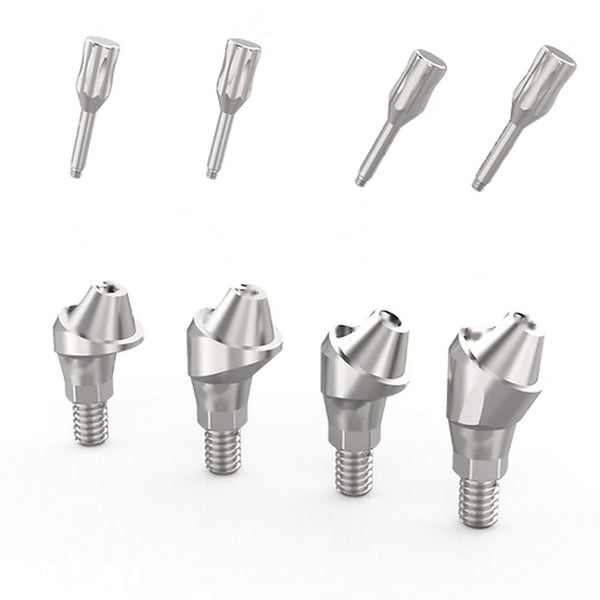
- 17° Angulated Multi-Unit Abutment Osstem® TS / Hiossen® ET Regular 2.5mm: as low as $33.15
- 30° Angulated Multi-Unit Abutment Osstem® TS / Hiossen® ET Regular 2.5mm: as low as $33.15
- 17° Angulated Multi-Unit Abutment Osstem® TS / Hiossen® ET Mini 2.1mm: as low as $33.15
- 30° Angulated Multi-Unit Abutment Osstem® TS / Hiossen® ET Mini 2.1mm: as low as $33.15
Drivers for straight multi-unit abutments
Both drivers are listed for straight Osstem®-compatible multi-unit abutments. The hand and ratchet driver is made for Straumann®-type torque ratchets.
- 15mm Length Ratchet Driver for Straight Multi-Unit Hex=3.3mm Compatible with Osstem®: as low as $27.20
- Multi-Unit Hand and Ratchet Insertion Driver, 15mm Length: as low as $20.40
Step 2: healing and impression
Multi-unit healing cap
Platforms listed: Osstem® / Hiossen® / Neodent® / Nobel® / MegaGen AnyRidge® multi-unit system
- Multi-Unit Healing Abutment / Healing Cap: as low as $10.20
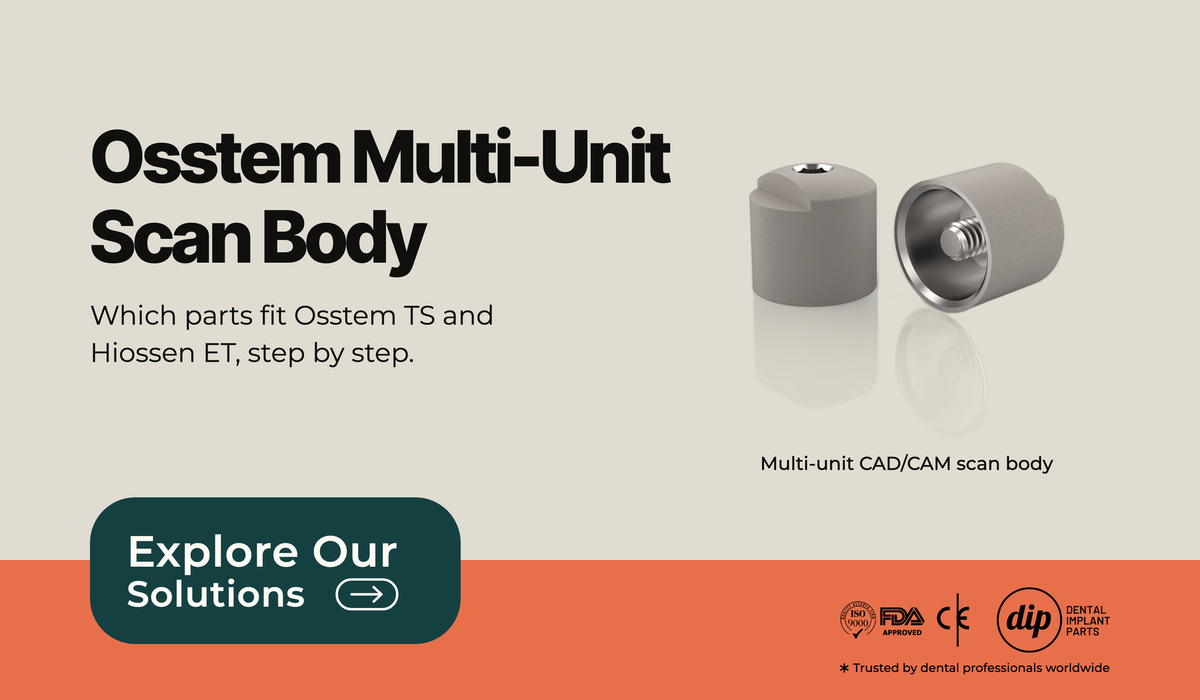
Multi-unit CAD/CAM scan body
Platforms listed: Osstem® / Hiossen® / Neodent® / Nobel® / MegaGen AnyRidge® multi-unit system
Titanium alloy grade 5 with aluminium oxide sandblasting, made to the shape of the Osstem® original.
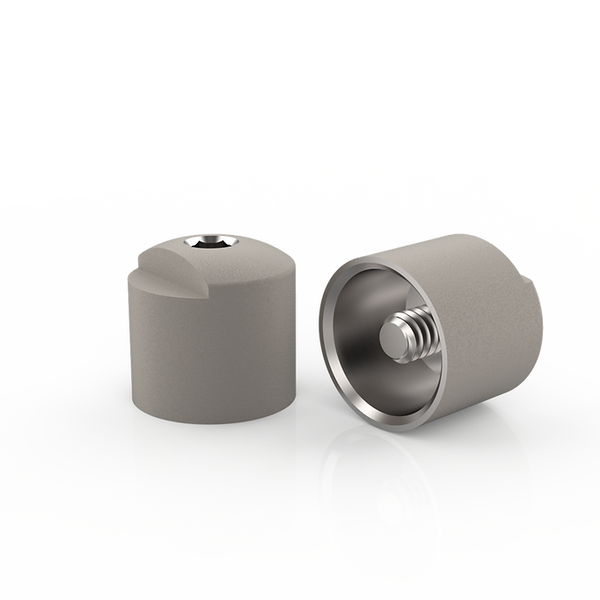
- Multi-Unit CAD/CAM Scan Body: as low as $16.15
Impression copings for a conventional impression
Platforms listed: Osstem® / Hiossen® / Neodent® / Nobel® / MegaGen AnyRidge® multi-unit system
- Multi-Unit Open Tray Impression Coping: as low as $11.90
- Multi-Unit Long Impression Open Tray Screw: as low as $5.10
- Multi-Unit Closed Tray Impression Coping: as low as $10.20
Step 3: model, Ti-base and provisional
Lab analogs
Platforms listed: the digital analog is listed for the Osstem® TS / Hiossen® ET multi-unit system; the classic analog for the Osstem® / Hiossen® / Neodent® / Nobel® / MegaGen AnyRidge® multi-unit system
The digital analog is made for 3D-printed models and comes with a fixation screw.
- Digital Lab Analog Osstem® TS / Hiossen® ET, Multi-Unit: as low as $13.60
- Multi-Unit Lab Analog: as low as $9.35
Ti-bases for the Geo CAD/CAM library
Platforms listed: Osstem® / Hiossen® / Neodent® / Nobel® / MegaGen AnyRidge® multi-unit system, Geo library
The 2 in 1 sleeve is a temporary sleeve that can be cut down and used as a Ti-base.
- Multi-Unit Ti-Base for Geo CAD/CAM Library: as low as $15.30
- Multi-Unit Ti Sleeve 2 in 1 for Geo CAD/CAM: as low as $10.20
Provisional and screws
Platforms listed: Osstem® / Hiossen® / Neodent® / Nobel® / MegaGen AnyRidge® multi-unit system
- Multi-Unit Temporary Titanium Sleeve Cylinder with Screw: as low as $10.20
- Multi-Unit System Sleeve Connection Screw: as low as $4.25
FAQ
Does the same scan body fit Osstem and Neodent multi-unit abutments?
On dip dental™, the multi-unit scan body is listed for the multi-unit system of Osstem®, Hiossen®, Neodent®, Nobel® and MegaGen AnyRidge®. The abutment underneath is different for each implant system.
Regular 2.5mm or Mini 2.1mm?
The angulated abutments for Osstem® TS / Hiossen® ET come in both versions. Match the one listed for the platform of the implant you placed.
Which Ti-base should the lab use?
The two Ti-bases listed here are for the Geo CAD/CAM library. Check with the lab which library it designs in before ordering.
See all parts in the Osstem® / Hiossen® compatible collection.