
A broken implant screw or fractured implant fixture is one of the most challenging complications an implantologist can face. Whether a prosthetic fixation screw has sheared off inside the implant channel or the implant body itself has fractured within the bone, retrieval requires dedicated, precision-engineered instruments - and the right clinical approach.
In this guide, we cover everything you need to know: why implant screws break, when to retrieve vs. monitor, and which tools are available - from single extraction drills to comprehensive kit systems. dip dental™ offers a complete range of broken screw and fractured fixture removal instruments, so every implantologist can be prepared for this complication when it arises.
Why Do Implant Screws Break?
Screw fracture is a known mechanical complication in implant dentistry. The most common causes include:
- Excessive occlusal load - parafunctional habits (bruxism, clenching) create forces beyond the screw's fatigue limit
- Incorrect torque application - under-torquing leads to micro-movement and metal fatigue; over-torquing causes immediate shear fracture
- Repeated screw loosening - each loosening event damages the thread, progressively weakening the screw
- Implant-abutment misfit - poor fit concentrates stress at the screw neck
- Unfavorable crown-to-implant ratios or cantilevers - biomechanical overload in the prosthetic design
- Corrosion or metal fatigue - especially in older or low-quality components
Two Types of Fracture: Fixation Screw vs. Implant Fixture
It is important to distinguish between two different clinical scenarios, as they require different instruments and approaches:
1. Broken Fixation Screw (Abutment / Prosthetic Screw)
The screw that connects the abutment or prosthetic component to the implant body has fractured - typically at or below the implant platform. The implant fixture remains intact in the bone. This is the more common scenario and is manageable with a dedicated extraction drill or screw retrieval kit.
2. Fractured Implant Fixture
The implant body itself has fractured within the bone - often transversally at the implant neck. This is a more serious situation requiring complete removal of the fixture from the bone. Both the broken screw retrieval tools and additional trephine or forceps instruments may be required to retrieve the fixture in its entirety before a new implant can be placed.
When Should You Remove It?
| Remove | Consider Monitoring |
|---|---|
| Implant cannot be restored prosthetically | Fragment is deeply embedded, implant is stable and asymptomatic |
| Patient has pain, swelling, or infection | Patient is medically compromised (high surgical risk) |
| Peri-implant bone loss is progressing | Patient declines surgery |
| New implant placement is planned | Implant is in a non-critical, non-aesthetic position |
In the majority of cases, retrieval is the recommended approach - it preserves bone, eliminates infection risk, and restores full function.


dip dental™'s Full Range of Broken Screw & Fixture Removal Instruments
dip dental™ offers instruments for every level of complexity - from a single extraction drill for straightforward cases to comprehensive kits for advanced clinical scenarios. Every implantologist should have at least one solution available in clinic.
1. DIP Drill for Broken Fixation Screw Removal
The DIP Drill for Broken Fixation Screw Removal is a targeted single-instrument solution for retrieving fractured fixation screws. It works by drilling into the center of the screw fragment to provide a grip point for extraction. Ideal for straightforward cases where the fragment is accessible and the implant channel is intact.
2. DIP Remove Drill for Broken Fixation Screw Extraction
The DIP Remove Drill is an evolution of the standard extraction drill concept - engineered for more reliable fragment engagement and controlled extraction torque. A precision instrument for the clinician who wants a single-piece, highly effective solution.
3. Compact Broken Implant Screw Removal Kit
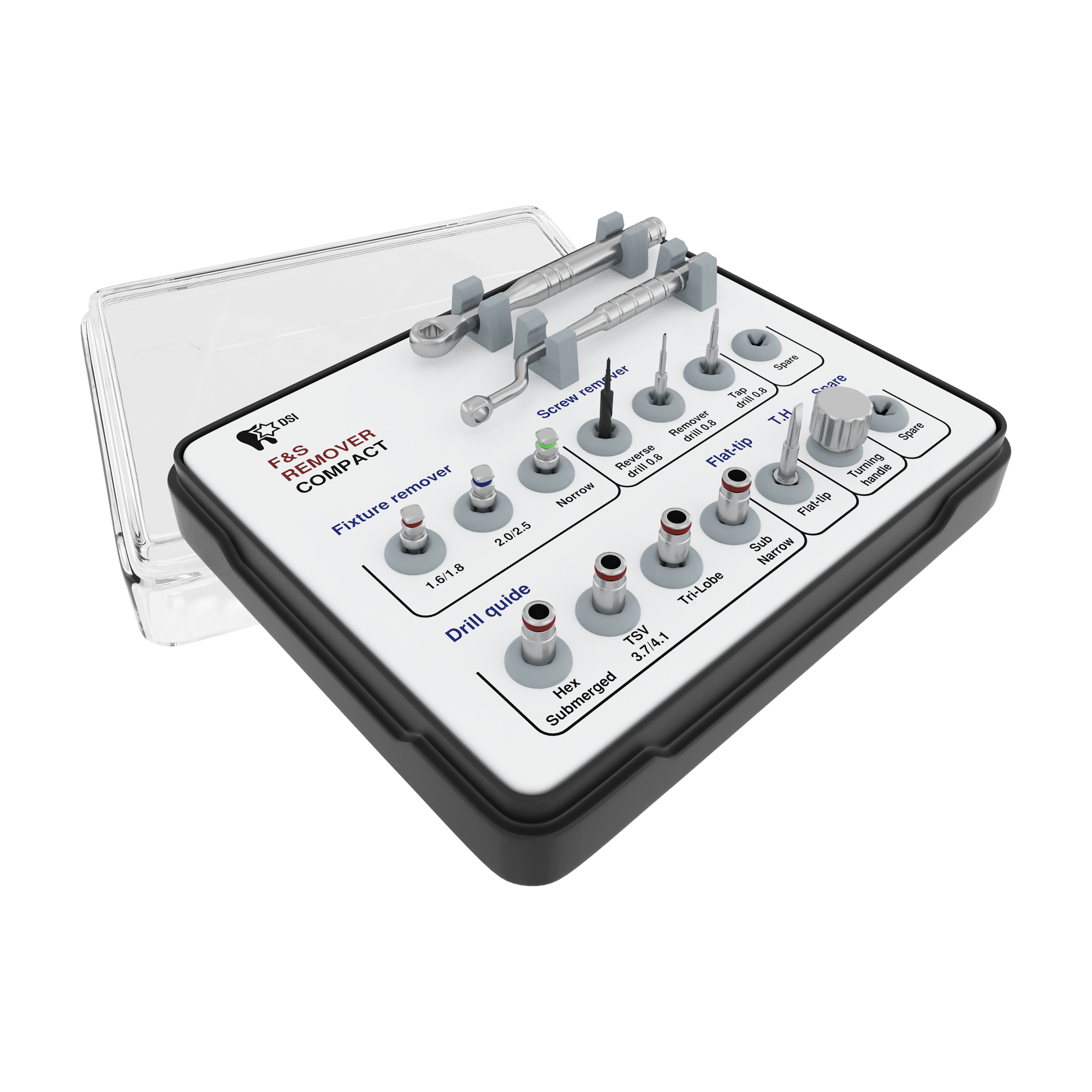
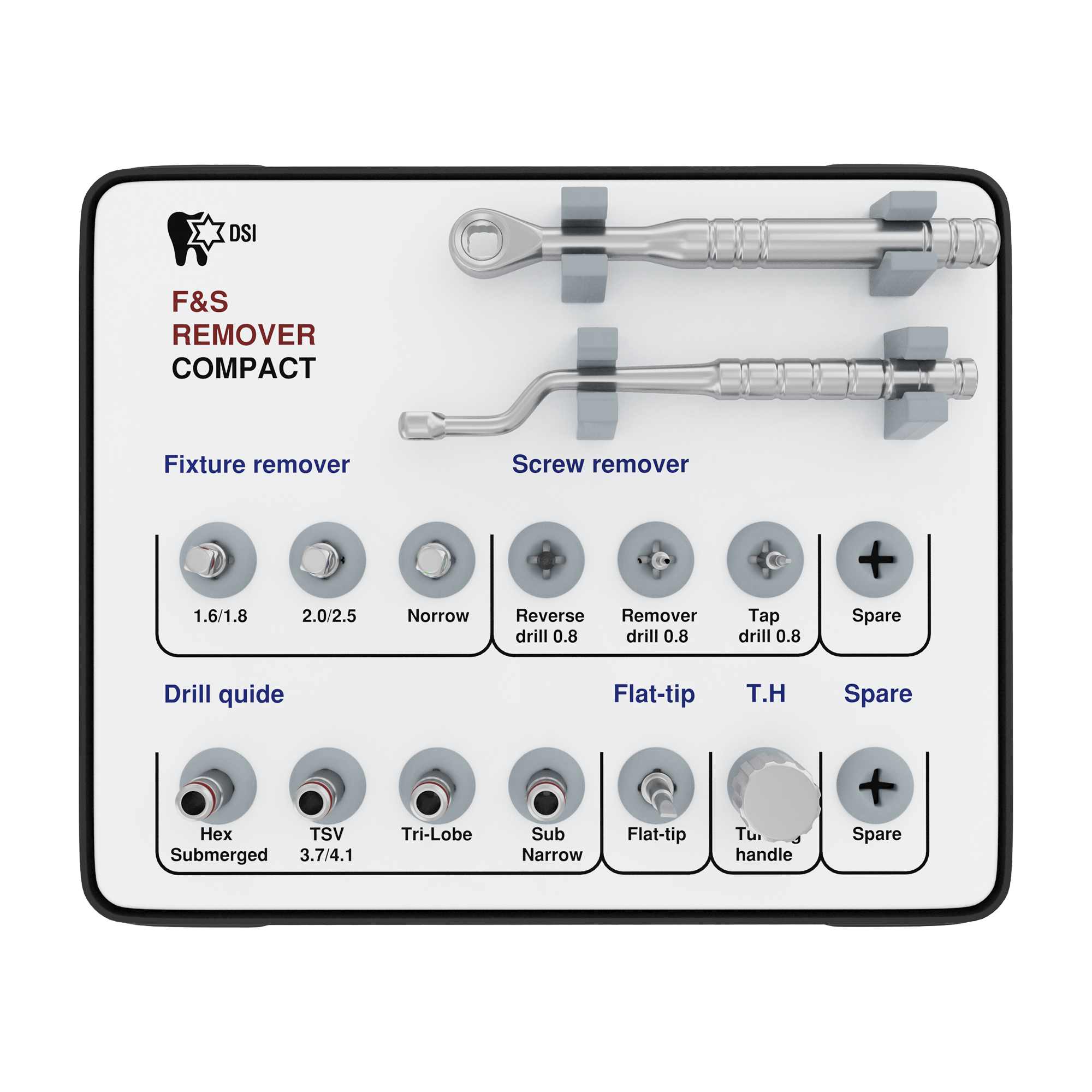
The Compact Broken Implant Screw Removal Kit is the go-to everyday solution. A portable, complete set that covers the most common clinical scenarios with left-hand reverse-threaded extractors, a centering guide tube, and a controlled-torque driver handle. Compatible with Internal Hex, Conical Connection, and most standard implant platforms.
- Left-hand reverse-threaded extractors in multiple sizes
- Guide tube for implant channel protection
- Driver handle with controlled torque
- Compact format for posterior access
4. Full Kit for Broken Implant Screw Removal & Extraction
The Full Kit for Broken Implant Screw Removal is the most comprehensive solution in the dip dental™ range. Designed for implantologists who want complete coverage across all platforms, screw sizes, and complexity levels - including both fixation screw retrieval and fractured implant fixture removal. If you want to be fully prepared for any extraction scenario, this is the kit.
5. Rhein83 Kit for Broken Fixation Screw Extraction
The Rhein83 Broken Screw Extraction Kit brings the precision engineering of the renowned Italian manufacturer Rhein83 to broken screw retrieval. Rhein83 is one of the most respected names in prosthetic dentistry globally, and their extraction kit reflects the same standards of quality and reliability found throughout their product range.
Which Kit Is Right for You?
| Product | Best For | Fixation Screw | Fixture Removal |
|---|---|---|---|
| DIP Drill | Single-instrument, straightforward cases | ✓ | - |
| DIP Remove Drill | Reliable single-drill retrieval | ✓ | - |
| Compact Kit | Everyday clinic use, most common platforms | ✓ | Partial |
| Full Kit | Maximum coverage, complex cases | ✓ | ✓ |
| Rhein83 Kit | Premium brand, clinics using Rhein83 systems | ✓ | - |
Step-by-Step: How Broken Screw Removal Works
- Assessment - Take a periapical X-ray to confirm fracture location and remaining fragment length. CBCT may be indicated for deep or complex fractures.
- Access - Remove the prosthetic restoration and abutment components to expose the implant channel.
- Guide tube placement - Insert the centering guide tube to protect the implant's internal threads during extraction.
- Extractor or drill engagement - Select the correct instrument size. Advance gently until it contacts the fragment and engages securely.
- Extraction - Apply steady counter-clockwise torque. Keep rotation slow and controlled to avoid thread damage.
- Verification - Confirm complete removal with a periapical X-ray before restoring.
Clinical Tips for Successful Retrieval
- Never use excessive force - if the instrument won't engage, try a different size first
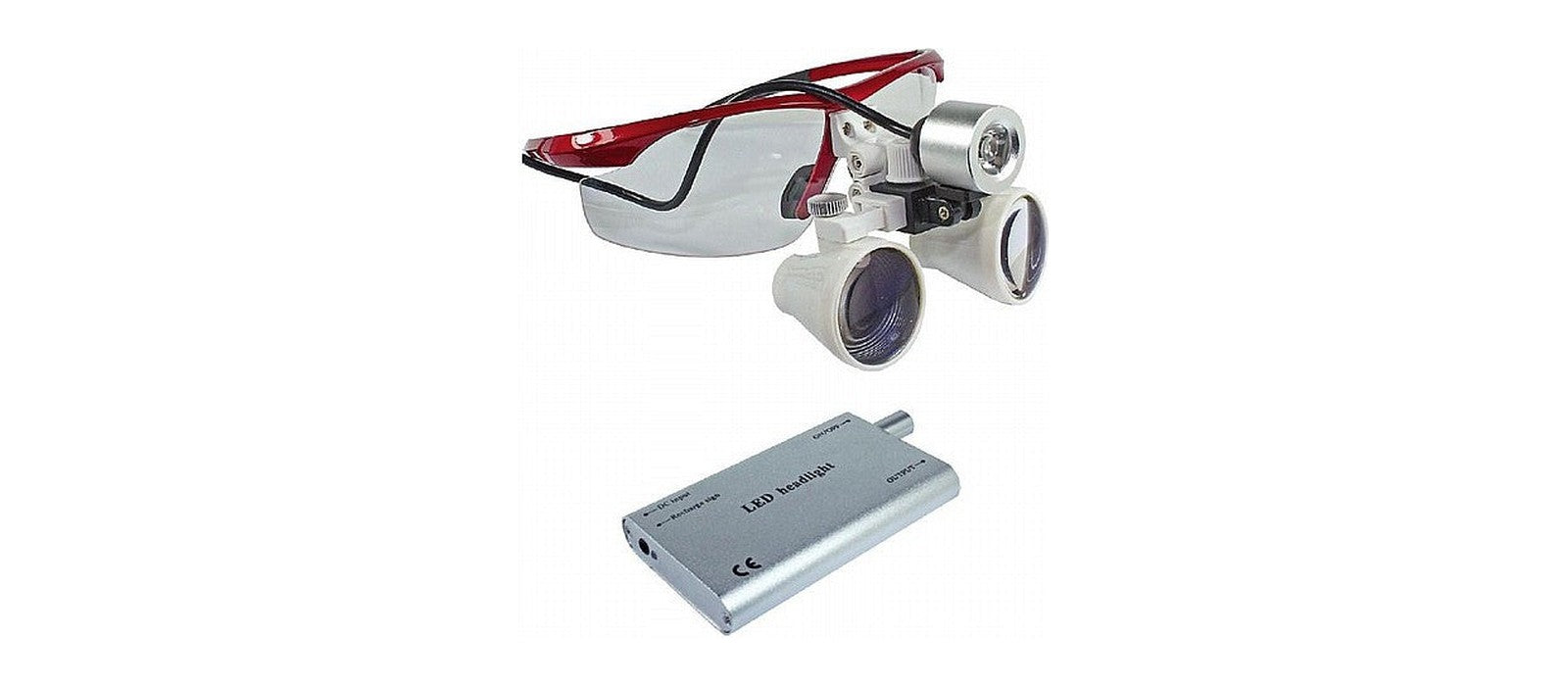
- Use magnification - a surgical loupe or microscope significantly improves visibility in the implant channel
- Keep the channel clear - irrigate before inserting any instrument
- Match instrument to screw diameter - an undersized extractor risks slippage and further fragment damage
- Work slowly - rushed retrieval is the most common cause of internal thread damage
Prevention: Avoiding Screw Fracture in the First Place
- Always use a calibrated torque wrench - never estimate torque manually
- Follow manufacturer-specified torque values for each screw type
- Replace screws that have been loosened and retightened multiple times
- Screen all implant patients for parafunctional habits - provide occlusal splints where indicated
- Review crown-to-implant ratios at the treatment planning stage
- Use only high-quality, FDA, CE & ISO approved prosthetic components
Frequently Asked Questions
Can a broken implant screw always be removed?
In most cases, yes - especially when the fragment is accessible and the implant channel is intact. Success depends on fracture depth, fragment length, and whether internal threads are undamaged. Deeply embedded or very short fragments may require ultrasonic instrumentation or specialist referral.
Will removing the broken screw damage the implant?
When performed correctly with the right instruments and a guide tube, the risk of implant thread damage is minimal. Damage most commonly occurs when incorrect instrument sizes are used or when excessive force is applied. Using a centering guide tube is essential.
What is the difference between the Compact Kit and the Full Kit?
The Compact Kit covers the most common implant platforms and screw sizes - ideal for everyday clinic use. The Full Kit provides a more comprehensive range of instrument sizes and is designed for complex cases, including fractured implant fixture removal. If you treat a high volume of implant patients, the Full Kit offers maximum preparedness.
Are dip dental™ instruments autoclavable?
Yes. dip dental™ broken screw removal instruments are made from medical-grade stainless steel and are designed for repeated autoclave sterilization cycles, making them suitable for routine clinical use.
Does dip dental™ offer free shipping on these instruments?
Yes. dip dental™ offers free worldwide shipping on orders above $299. All products are FDA, CE & ISO approved and available at competitive prices.
Be Prepared - Before the Emergency Happens
A broken implant screw is never a question of if - it's a question of when. Having the right instrument in your clinic means you can handle this complication confidently, quickly, and without referral.
dip dental™ offers the complete range - from a single precision drill to a comprehensive full kit - all FDA, CE & ISO approved, competitively priced, with free worldwide shipping on orders above $299.