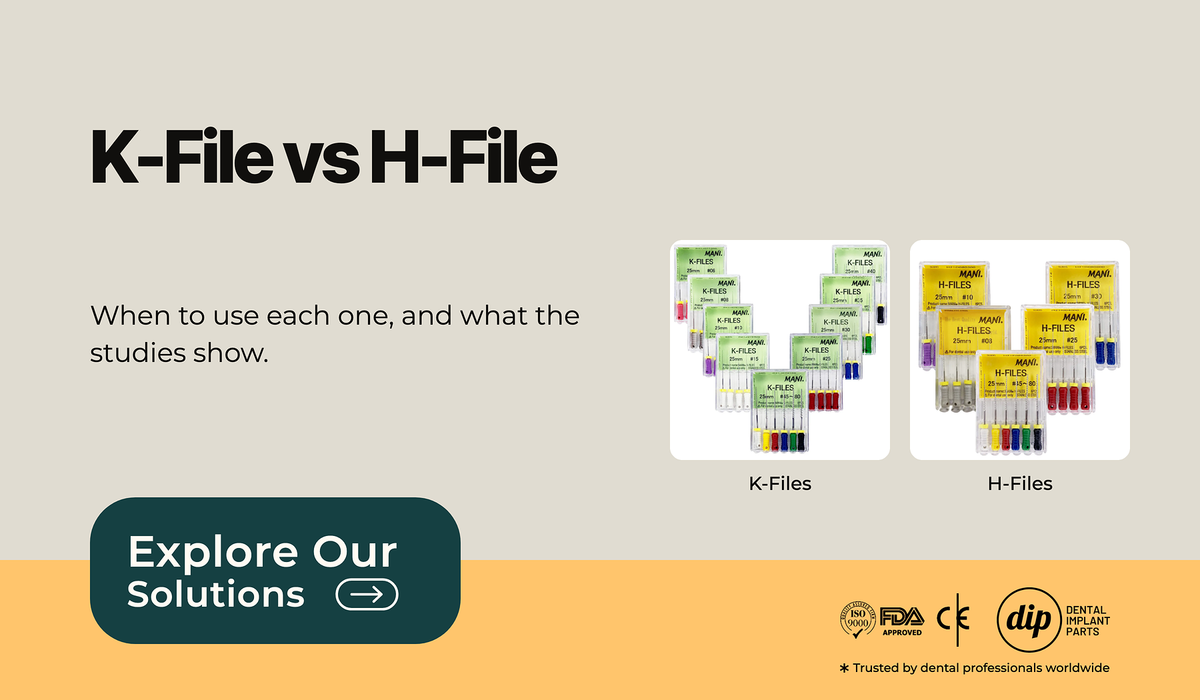
Stainless steel hand files remain part of most root canal kits, including in practices that shape with rotary nickel-titanium. They are used to locate and negotiate canals, confirm patency, enlarge in small steps and remove filling material during retreatment. The two hand files stocked most often are the K-file and the H-file, also called the Hedström file.
On the tray the two look alike, but they cut with different motions, and each has its own steps in a procedure.
How a K-file and an H-file cut
The K-file cuts in rotation and in filing
The K-file has a tight spiral of cutting edges along its working part. It cuts when it is turned and when it is filed in and out. That makes it the instrument for scouting a canal and for the first steps of enlargement.
A review of cutting tests on endodontic hand instruments found that in rotary motion, flexible stainless steel reamers and K-files gave the best results (Tepel and Schäfer, 1997). Rotation is also the basis of the balanced-force technique for curved canals (Roane et al., 1985).
The H-file cuts on the pull stroke
The H-file's cutting edges are shaped like a stack of cones, angled so the file cuts as it is withdrawn. It removes dentin quickly with a push-pull stroke and is used in that motion rather than rotated.
The same review found that in linear motion, stainless steel Hedström files from some manufacturers cut significantly better than Hedström files of other brands. In an earlier study in simulated curved canals, H-files shaped faster than K-files with an in/out filing motion. K-files created wider zips, and neither file gave acceptable curved-canal shapes with that motion alone (Alodeh and Dummer, 1989).
When to use which
K-file for negotiation and glide path
Small K-files, #06 to #10, are the usual first instruments in a narrow or calcified canal because they can be turned gently down to length. Any step that needs a watch-winding or balanced-force motion also belongs to the K-file.
H-file for enlarging straight sections
Once a straight canal section is negotiated, the pull stroke of the H-file enlarges and cleans the walls efficiently. In curved sections, the 1989 study found that in/out filing alone did not give acceptable shapes with either file.
H-file for gutta-percha removal in retreatment
In a micro-CT study of curved molar canals, retreatment with Hedström files left less residual filling material than a rotary NiTi system. The rotary files were faster, but three of them fractured, while the Hedström group had no procedural errors (Rödig et al., 2014).
In straight single-root canals, a 2024 study found no significant difference in remaining gutta-percha between H-files and a ProTaper Universal® rotary and retreatment combination (Atique et al., 2024).
Inspect files before every use
A study of 160 H-files discarded after clinical use found two failure patterns. Sizes #08 to #15 failed by plastic deformation, while sizes #20 and above tended to fracture, with signs of fatigue (Zinelis and Al Jabbari, 2019). Any file with unwound or stretched flutes should be discarded, and larger H-files should not be kept in service until they look worn, since their reported failure mode was fatigue fracture.
Mani hand files at dip dental™
Hand files are consumables, so the cost per file adds up. dip dental™ stocks Mani stainless steel K-files and H-files in packs of 6, in 21, 25 and 31 mm lengths. Each length comes in single sizes from #06 to #80 or in the assorted sets #15-40 and #45-80. Every pack is as low as $5.95 with volume pricing, which is under $1 per file.
Mani K-Files

Stainless steel, made in Japan, with heat-proof plastic handles that can be autoclaved and a pre-mounted silicone stop.
- Mani Root Canal SS K-Files 6/pk 21mm: as low as $5.95
- Mani Root Canal SS K-Files 6/pk 25mm: as low as $5.95
- Mani Root Canal SS K-Files 6/pk 31mm: as low as $5.95
Mani H-Files (Hedström)

Stainless steel, made in Japan, with pre-mounted silicone stoppers and a precision cutting angle.
- Mani Root Canal Hedstrom SS H-Files 6/pk 21mm: as low as $5.95
- Mani Root Canal Hedstrom SS H-Files 6/pk 25mm: as low as $5.95
- Mani Root Canal Hedstrom SS H-Files 6/pk 31mm: as low as $5.95
For locating canals
A set of three K-file-shaped orifice openers, #10, #15 and #20, with stainless steel tips and plastic handles, for locating blocked canals in posterior teeth. Autoclavable.
- UDG K-File Micro-Opener tool: as low as $18.70
See all sizes in the K-Files and Hedstrom Files collections.
FAQ
Can an H-file be rotated like a K-file?
No. The H-file is a push-pull instrument. A step that needs rotation, such as watch-winding while negotiating a canal, belongs to the K-file.
What do the handle colours mean?
Handles follow the ISO colour code: #06 pink, #08 grey, #10 purple, #15 white, #20 yellow, #25 red, #30 blue, #35 green and #40 black. From #45 the sequence starts again at white.
Which length should a practice stock?
It depends on working length. 25 mm suits most teeth, 21 mm leaves more room in posterior teeth or with limited mouth opening, and 31 mm is for long roots such as canines.
Are H-files more expensive than K-files?
Not at dip dental™. Mani K-files and H-files are priced the same, as low as $5.95 per pack of 6.
This article is written for dental professionals and does not replace the instructions for use supplied with each instrument.