Modern full-arch implant dentistry requires more than simply choosing the right implant. The restorative components above the implant can determine how efficiently a case moves from surgery to impression, digital design, laboratory production and final restoration.
The M1.4 Multi-Unit Abutment system from dip dental™ was developed around exactly that idea: provide clinicians and dental laboratories with a complete restorative ecosystem rather than an isolated component.
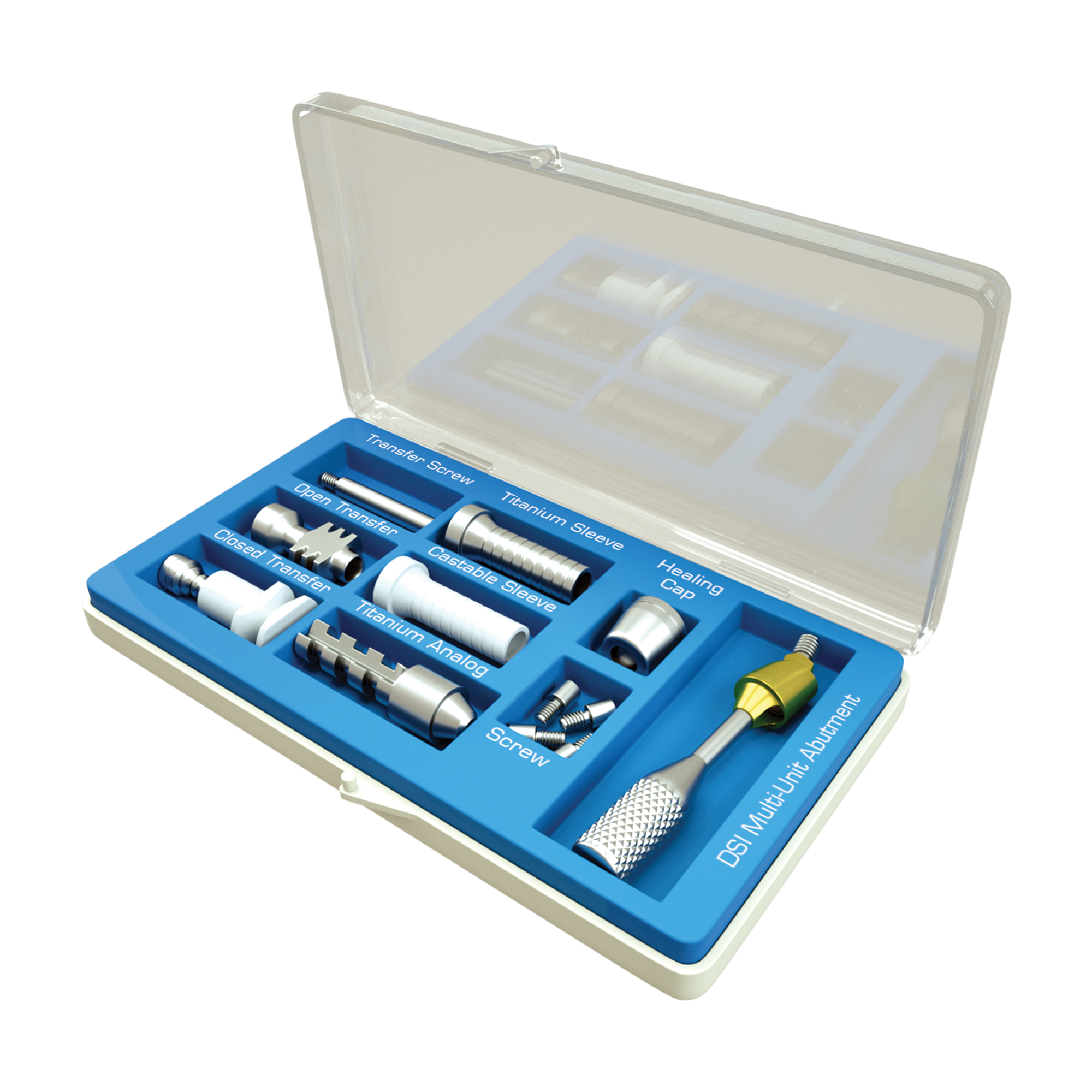
From straight and angulated Multi-Unit Abutments to impression components, analogs, healing caps, prosthetic screws and a complete digital workflow with scan bodies, Ti-Bases and digital analogs, the system provides the components required for both conventional and digital workflows.
And because components can be purchased individually or as complete sets, clinics and laboratories can choose exactly what they need - without unnecessarily increasing the cost of each case.
What Is an M1.4 Multi-Unit Abutment?
A Multi-Unit Abutment, commonly referred to as an MUA, creates a standardized restorative platform above the implant.
This is particularly useful in multiple-unit and full-arch screw-retained restorations, where the clinician and technician need to manage implant depth, angulation and restorative access while creating a predictable prosthetic platform.
The dip dental™ M1.4 Multi-Unit Abutment collection is designed for Internal Hex implant systems and includes both narrow and regular platform solutions.
But one of its most important advantages is that the MUA itself is only the beginning.
The system is supported by the restorative and digital components needed to continue the workflow after placement.
Straight and Angulated M1.4 Multi-Unit Abutments
Implants cannot always be placed in an ideal prosthetic position.
Anatomy, bone availability and surgical considerations may require implants to be placed at different angles.
This is where angulated Multi-Unit Abutments become particularly valuable.
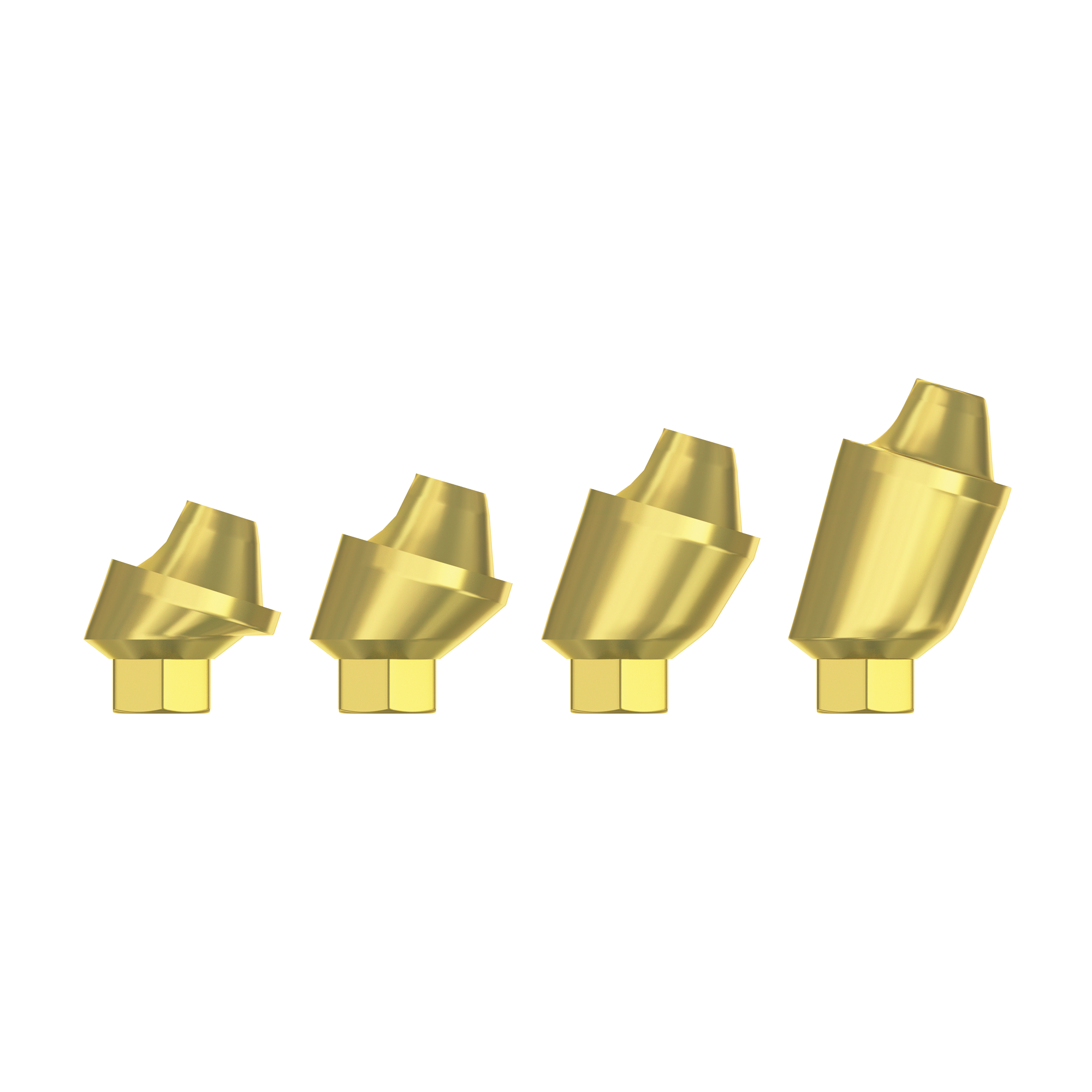
The M1.4 range includes both straight and angulated MUA options, allowing the restorative platform and screw access to be better managed according to the implant position.
The system is designed to support restorative correction up to 60 degrees.
This flexibility can be particularly useful in full-arch cases involving multiple implants positioned at different angles.
Rather than forcing the final restoration to follow the exact trajectory of every implant, the MUA helps create a more manageable restorative platform above the implants.
Why Angulation Matters in Full-Arch Implant Dentistry
Imagine four or six implants supporting a full-arch restoration.
Even small differences in implant trajectory can create significant challenges when the restoration is designed.
The goal is not simply to "correct an angle." The objective is to create a restorative configuration that allows the prosthetic components to work together predictably.
Having access to both straight and angulated MUAs gives the clinician more flexibility to select the appropriate restorative solution for each implant position.
This is particularly important when planning screw-retained restorations where screw access, prosthetic space and restorative design all need to be considered.
More Than an MUA: A Complete M1.4 Restorative System
One of the biggest advantages of the dip dental™ M1.4 system is the availability of the components surrounding the MUA.
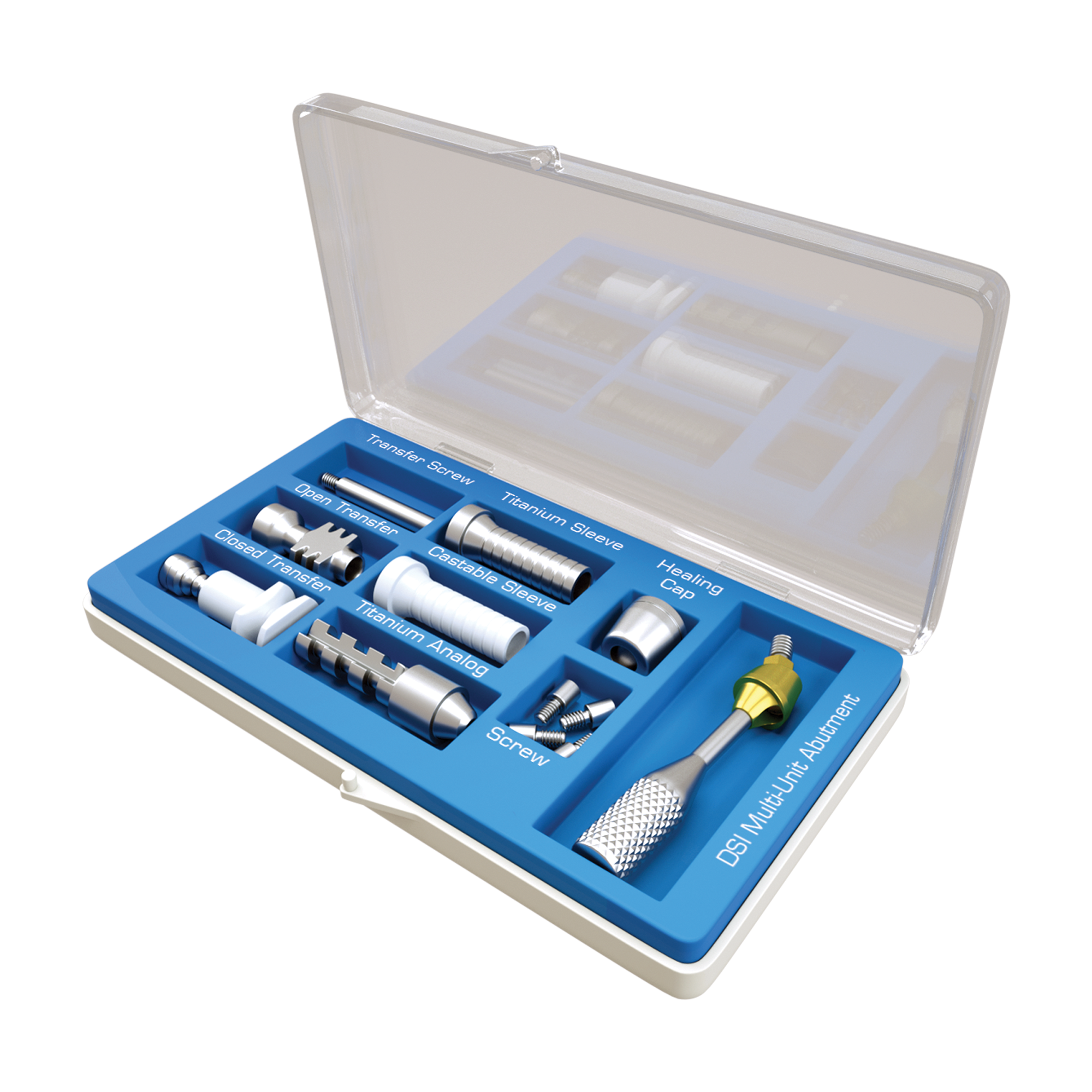
The dedicated M1.4 Multi-Unit Parts collection currently includes:
- Open-tray impression transfers
- Snap-on closed-tray impression transfers
- Standard analogs
- Protective healing caps
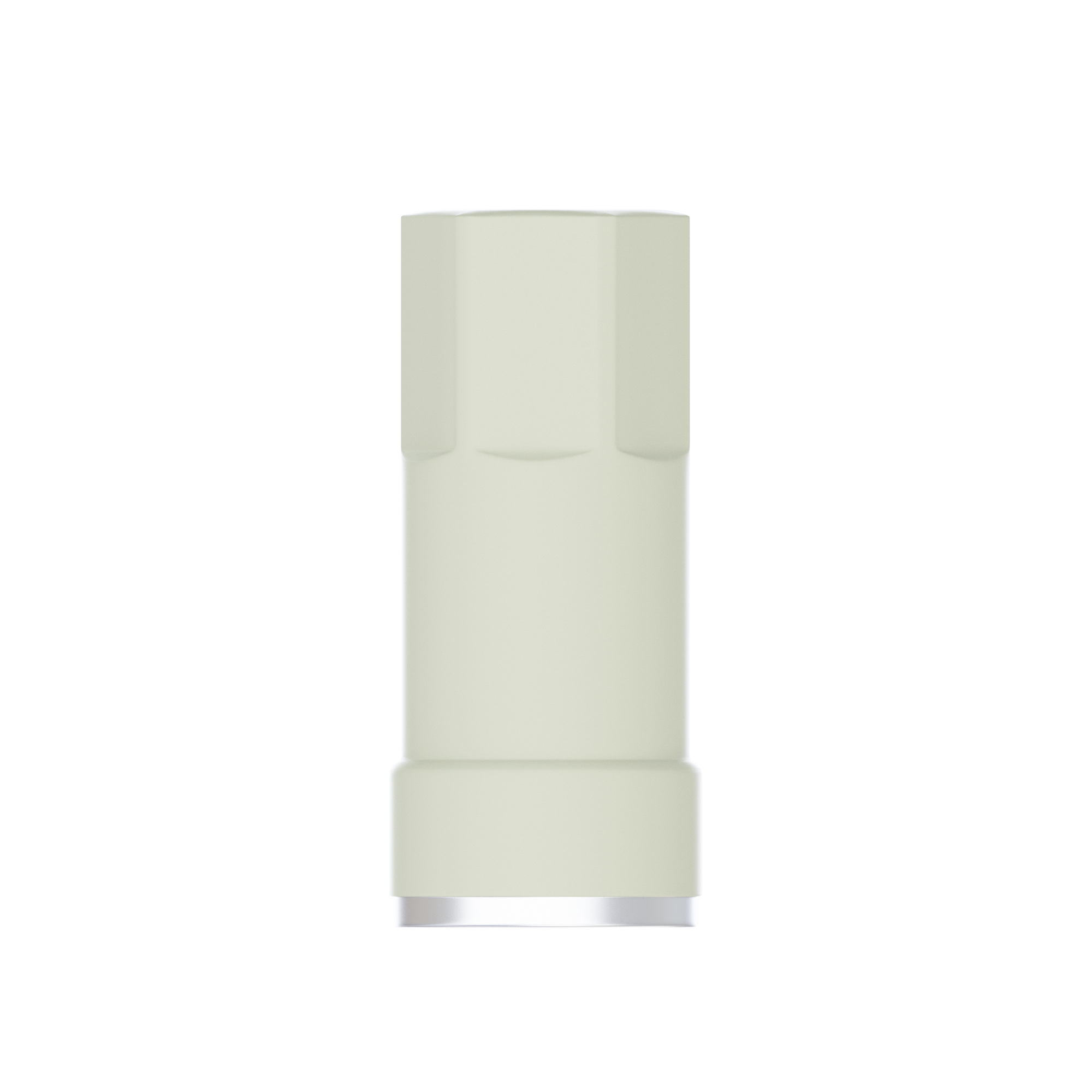
- Castable sleeves
- Titanium sleeves
- Metal position holders
- Prosthetic fixation screws
- M1.4 abutment screws
This means the clinician or technician does not need to purchase the MUA and then search elsewhere for the components required to complete the restoration.
That can make inventory management considerably easier for clinics and laboratories performing full-arch cases regularly.


Conventional or Digital: Choose Your Workflow
Not every clinic or laboratory works the same way.
Some cases still follow a conventional impression and model workflow. Others are almost entirely digital.
The M1.4 ecosystem supports both.
For conventional workflows, impression transfers, standard analogs, sleeves and other restorative components are available.
For digital dentistry, dip dental™ provides a dedicated range of Digital Parts for Multi-Unit Abutments, including components for M1.4 as well as M1.6 and M1.7 systems.
The M1.4 Digital Workflow
Digital full-arch dentistry depends on accurate communication between the mouth, scanner, CAD software, printed model and final restoration.
The M1.4 digital workflow provides three particularly important components:
PEEK Scan Post / Scan Body
The scan component allows the position and orientation of the MUA to be transferred into the digital environment.
The current M1.4 digital range includes a PEEK Scan Post Body 4.9 mm for Premium Multi-Unit M1.4.
Digital Analog for 3D Printing
Once a model is digitally designed and printed, the physical model needs to reproduce the MUA position accurately.
For this stage, dip dental™ offers a Digital Analog for 3D Printing 4.9 mm for Premium Multi-Unit M1.4.
Ti-Base CAD/CAM
For CAD/CAM restorative workflows, the range includes a 4.9 mm Ti-Base for Premium Multi-Unit M1.4.
Together, these components allow the workflow to move from scanning to CAD design, model production and final prosthetic fabrication using components built around the same MUA platform.
Exocad and 3Shape Digital Libraries
Hardware alone does not create a digital workflow.
The CAD software needs to understand the exact geometry of the restorative components being used.
For this reason, the dip dental™ digital MUA components are supported by validated digital libraries for Exocad and 3Shape.
This allows dental laboratories to incorporate the relevant component geometry into their CAD/CAM workflow rather than trying to manually adapt a generic component.
The workflow becomes:
MUA → Scan Body → Digital Scan → Exocad / 3Shape → CAD Design → 3D Printed Model + Digital Analog → Ti-Base / Final Restoration
For laboratories already working digitally, this is an important distinction.
You are not simply purchasing an abutment.
You are purchasing into a restorative workflow.
Buy a Single MUA or a Complete Set
Another practical advantage is flexibility in how the components are purchased.
A clinic may already have its restorative components and simply need to replace or purchase a single MUA.
Another clinic may prefer to receive a complete MUA set with the supporting components required for the case.
Both options are available.
The M1.4 collection currently lists individual straight and angulated MUAs as well as Full Set configurations for selected Internal Hex RP Ø2.42 mm solutions.
This is especially useful for different types of buyers.
A high-volume laboratory may prefer to maintain its own inventory and purchase individual components in larger quantities.
A clinician performing an occasional full-arch case may prefer the convenience of a complete set.
Buy what your workflow requires - not components you don't need.
M1.4 Multi-Unit Abutment Pricing
Price is another area where the dip dental™ system becomes particularly attractive.
Individual straight M1.4 Multi-Unit Abutments start at $25, with volume pricing shown as low as $21.25.
Angulated M1.4 MUAs start at $39, with listed volume pricing from $33.15.
Selected complete straight MUA sets are listed at $69, while selected angulated full sets start at $85.
The supporting components are also competitively priced.
In the M1.4 parts collection, standard analogs are $9, protective healing caps $8, impression transfers $12, titanium sleeves $14 and prosthetic fixation screws $5, before volume discounts.
For the digital workflow, M1.4 Ti-Bases and PEEK scan posts are $18 and the M1.4 digital analog is $16, with lower volume pricing.
For a laboratory or clinic completing multiple full-arch cases every month, component cost can quickly become significant.
This is where a complete compatible ecosystem at competitive pricing can make a meaningful difference.
Buy More, Save More
Full-arch dentistry rarely involves purchasing one component forever.
Laboratories, implant clinics and distributors often require repeated quantities of MUAs, screws, analogs, scan bodies and restorative components.
dip dental™ therefore provides volume-based pricing on many M1.4 products.
Volume reductions apply to the MUAs as well as the conventional and digital restorative components.
This makes the system relevant not only for an individual case but also for laboratories and clinics looking to reduce their average component cost over a larger number of restorations.
M1.4, M1.6 and M1.7: Building a Broader MUA Workflow
The digital collection is not limited to M1.4.
dip dental™ also carries corresponding digital components for M1.6 and M1.7 Multi-Unit systems, including Ti-Bases, scan posts and digital analogs.
For a laboratory working across different MUA connections, this creates a broader digital component ecosystem instead of a single isolated product family.
The key is always to confirm the correct MUA system and connection before selecting restorative or digital components.
Why a Complete MUA Ecosystem Matters
There is a major difference between selling a Multi-Unit Abutment and providing a complete Multi-Unit restorative solution.
A complete system should support the case from the implant level through to the final restoration.
With the dip dental™ M1.4 ecosystem, that can include:
Straight & angulated MUAs → healing and impression components → analogs → screws & sleeves → scan bodies → digital analogs → Ti-Bases → CAD/CAM libraries.
That continuity is particularly valuable for laboratories and clinics that want to standardize their workflow and reduce the time spent sourcing individual components.
A Smart M1.4 Solution for Clinics and Dental Laboratories
The M1.4 Multi-Unit system is designed around flexibility.
Choose a straight or angulated MUA according to the restorative situation. Use a conventional impression workflow or move into a fully digital CAD/CAM process. Purchase a single component when that is all you need, or select a complete set for convenience.
And importantly, do it at a component cost that makes sense for both individual cases and higher-volume workflows.
Explore the M1.4 Multi-Unit Abutments, browse the complete range of M1.4 Multi-Unit Parts, or discover the Digital Parts for Multi-Unit Abutments.
One system. Conventional or digital. Single components or complete sets. Built for a more efficient restorative workflow.
Frequently Asked Questions About M1.4 Multi-Unit Abutments
What is an M1.4 Multi-Unit Abutment?
An M1.4 Multi-Unit Abutment is part of a restorative MUA system using an M1.4 connection at the prosthetic level. dip dental™ offers M1.4 solutions for selected Internal Hex implant systems together with conventional and digital restorative components.
Are straight and angulated M1.4 Multi-Unit Abutments available?
Yes. The dip dental™ M1.4 collection includes straight and angulated options, supporting restorative workflows up to 60 degrees.
Can I purchase only the Multi-Unit Abutment?
Yes. Individual MUAs are available, while selected configurations are also offered as complete sets.
Does the M1.4 system support digital dentistry?
Yes. The digital range includes M1.4 Ti-Bases, PEEK scan posts and digital analogs for 3D printing, supported by Exocad and 3Shape libraries.
Are conventional impression components available?
Yes. The M1.4 range includes open-tray and snap-on closed-tray impression transfers, standard analogs and other conventional restorative components.
How much does an M1.4 Multi-Unit Abutment cost?
At the time of writing, straight individual M1.4 MUAs are listed from $25 and angulated versions from $39, with lower volume pricing available. Selected full sets are listed from $69 for straight and $85 for angulated configurations. Prices can change, so current product pages should be checked before ordering.
Are M1.6 and M1.7 digital MUA components also available?
Yes. The digital MUA collection includes Ti-Bases, scan posts and digital analogs for M1.4, M1.6 and M1.7 systems.
Who is the M1.4 system designed for?
The system is particularly relevant for implant clinicians, restorative dentists and dental laboratories performing multi-unit and full-arch screw-retained restorations.