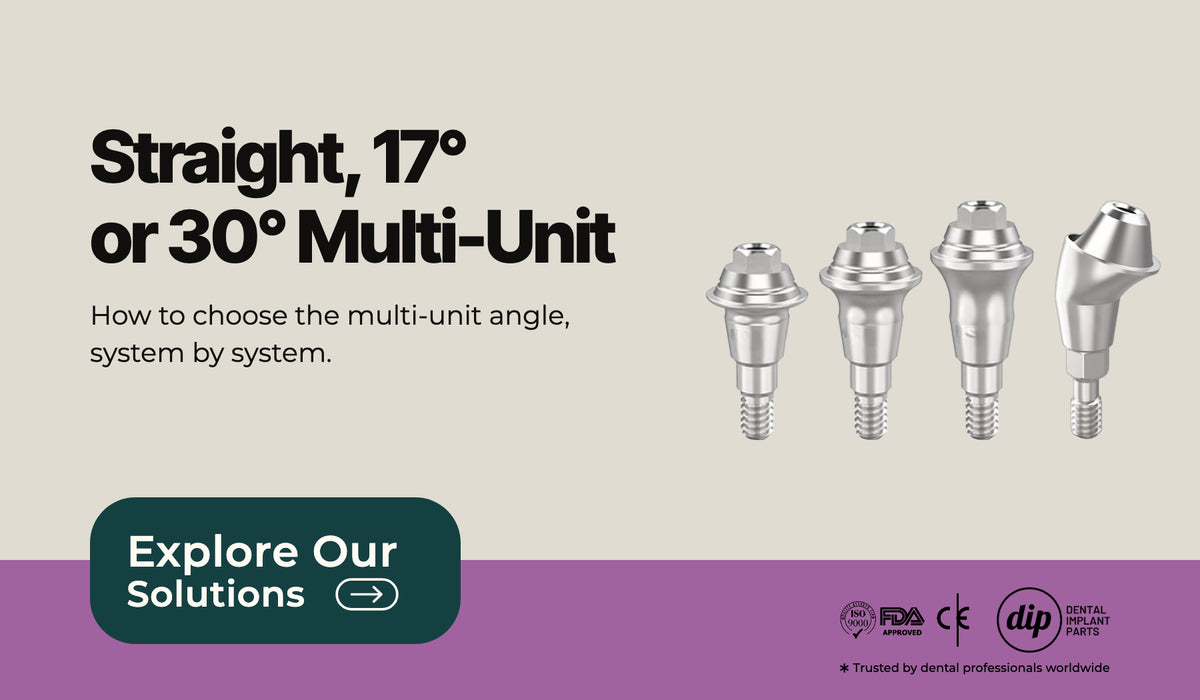
In a screw-retained full-arch case, every implant gets its own multi-unit abutment, and the angle is chosen implant by implant. Straight, 17° and 30° abutments can all appear in the same arch, depending on the inclination of each implant.
This guide covers what the angle does, what the published studies say about tilted implants and angled abutments, and the straight, 17° and 30° parts dip dental™ lists for each implant system.
What the angle on a multi-unit abutment does
Multi-unit abutments are used to compensate for implant angulation and to give access for screw-retained restorations, particularly in complete-arch work (Materials, 2026, critical review).
We did not find a study that sets a cut-off between 17° and 30°. In practice the choice comes from the measured inclination of each implant, on the CBCT plan or on the model, and from where the screw channel needs to exit.
Tilted implants: what the evidence says
A meta-analysis pooled 5,029 tilted implants (82 failures, 1.63%) and 5,732 axially placed implants (104 failures, 1.81%). Across all studies the difference was not significant. When only maxillary studies were pooled, tilted implants failed more often (RR 1.70, 95% CI 1.05-2.74), while in the mandible the difference was not significant (Chrcanovic et al., Journal of Dentistry, 2015).
A later systematic review found no differences in implant survival, marginal bone loss, prosthesis survival or patient-reported outcomes between tilted and axial implants. The authors also noted that only one level II study compared the two directly (Lin and Eckert, Clinical Oral Implants Research, 2018).
Angled or straight abutment: mixed findings
The data on the abutment angle itself is limited and points in different directions:
- In a retrospective study of 50 patients with 256 implants, 30° angled multi-unit abutments on posterior implants were associated with greater marginal bone loss than straight ones (Clinical Implant Dentistry and Related Research, 2026).
- In another retrospective study of 142 implants in full-arch cases, the multi-unit abutment angle had no effect on bone resorption around posterior implants (Malchiodi et al., Clinical Implant Dentistry and Related Research, 2018).
- In a laboratory study, the 30° group lost more screw torque than the straight group before cyclic loading, and all of its prosthetic screws showed deformation. After cyclic loading, screw loosening was expected at the same rate in all groups (Journal of Prosthodontics, 2026).
Retrospective and laboratory data like this cannot show that one angle is better than another. What it supports is planning the angle per implant and checking the prosthetic screws at recall.
Check the top thread before ordering upper parts
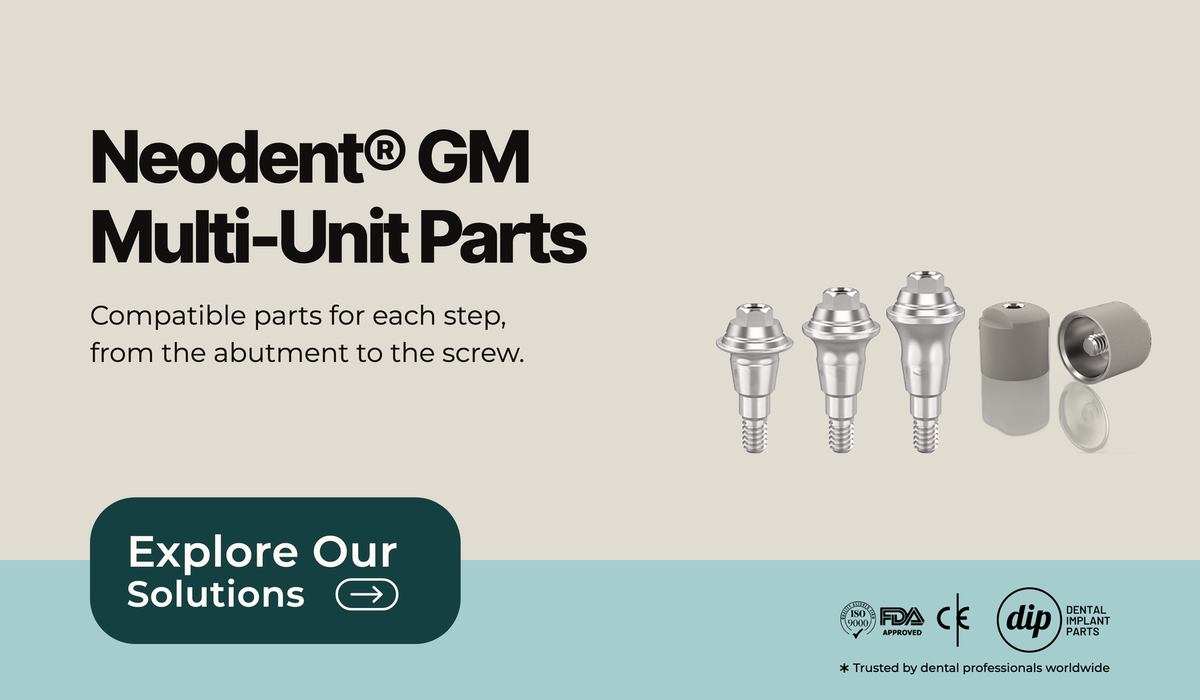
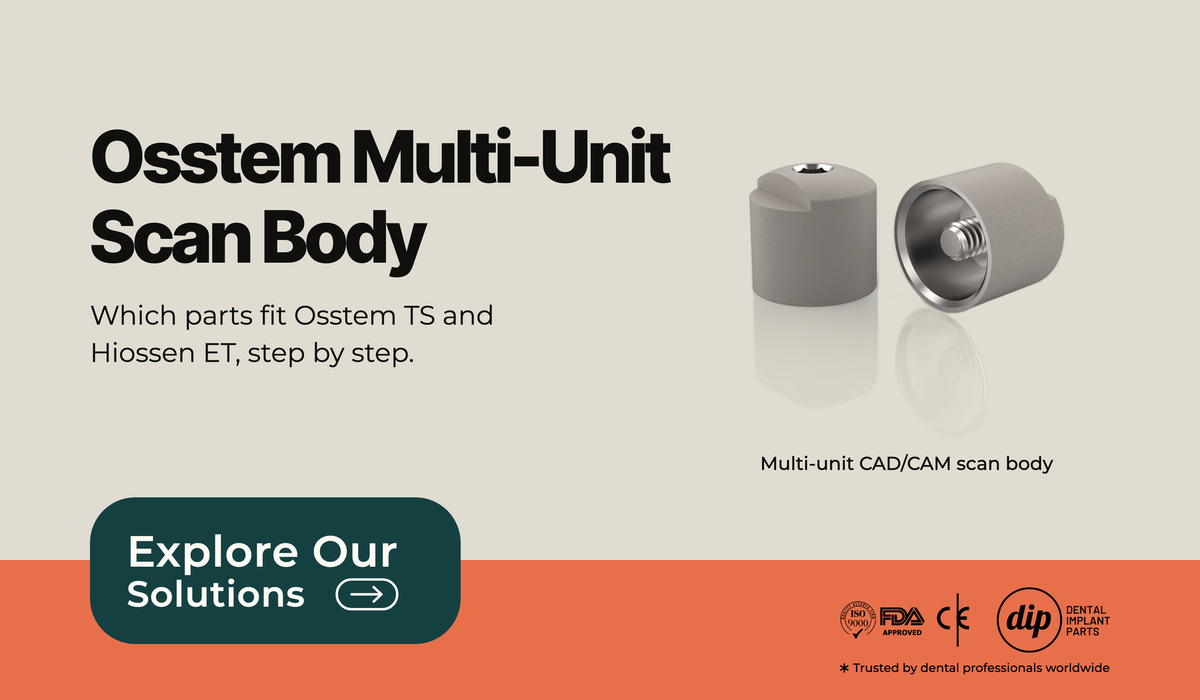
The abutment is chosen by the implant system, but the scan body, analog, impression copings and Ti-base connect to the top of the multi-unit abutment. On our product pages the Neodent® GM compatible multi-unit abutments list an M1.4 top thread, compatible with Neodent®, Osstem® and MegaGen® multi-unit parts, while the MIS® Seven SP compatible angled abutment lists M1.6. Order the upper parts for the thread on the abutment you place.
Straight, 17° and 30° multi-unit abutments by implant system
Prices below are the lowest tier price on each product page. Check each page for the gingiva heights available.
Neodent® GM Grand Morse®
Platforms listed: Neodent® GM Grand Morse®
- Straight Multi-Unit Abutment Compatible with Neodent GM® Grand Morse: as low as $21.25
- 17° Angled Multi-Unit Abutment Compatible with Neodent GM® Grand Morse: as low as $33.15
- 30° Angled Multi-Unit Abutment Compatible with Neodent GM® Grand Morse: as low as $33.15
MegaGen AnyRidge®
Platforms listed: MegaGen AnyRidge®
- Straight Multi-Unit Abutment Compatible with MegaGen AnyRidge®: as low as $18.70
- 17° Angled Multi-Unit Abutment Compatible with MegaGen AnyRidge®: as low as $33.15
- 30° Angled Multi-Unit Abutment Compatible with MegaGen AnyRidge®: as low as $33.15
MegaGen AnyOne®
Platforms listed: MegaGen AnyOne®
- Straight Multi-Unit Abutment MegaGen AnyOne® Compatible: as low as $18.70
- 17° Angulated Multi-Unit Abutment MegaGen AnyOne® Compatible: as low as $33.15
- 30° Angulated Multi-Unit Abutment MegaGen AnyOne® Compatible: as low as $33.15
MegaGen® BlueDiamond RC
Platforms listed: MegaGen® BlueDiamond RC
- MegaGen® BlueDiamond RC Compatible Straight Multi-Unit Abutment: as low as $21.25
- MegaGen® BlueDiamond RC Compatible 17° Angled Multi-Unit Abutment: as low as $33.15
- MegaGen® BlueDiamond RC Compatible 30° Angled Multi-Unit Abutment: as low as $33.15
Osstem® TS / Hiossen® ET
Platforms listed: Osstem® TS / Hiossen® ET, Regular 2.5mm (Mini 2.1mm angled versions are in our Osstem guide)
- Straight Multi-Unit Abutment Osstem TS® / Hiossen ET® Compatible: as low as $18.70
- 17° Angulated Multi-Unit Abutment Osstem® TS / Hiossen® ET Regular 2.5mm: as low as $33.15
- 30° Angulated Multi-Unit Abutment Osstem® TS / Hiossen® ET Regular 2.5mm: as low as $33.15
Dentium®
Platforms listed: Dentium®
- Straight Multi-Unit Abutment Dentium® Compatible: as low as $18.70
- 17° Angulated Multi-Unit Abutment Dentium® Compatible: as low as $33.15
- 30° Angulated Multi-Unit Abutment Dentium® Compatible: as low as $33.15
MIS® Seven SP
Platforms listed: MIS® Seven SP
- MIS® Seven SP Compatible Concave Straight Multi-Unit Abutment: as low as $21.25
- MIS® Seven SP Compatible 17° / 30° Angled Multi-Unit Abutment: as low as $33.15
FAQ
Is a 17° or a 30° multi-unit abutment better?
We did not find a clinical study that compares the two directly. The angle is chosen from the inclination of each implant and where the screw channel needs to exit.
Can straight and angled abutments be used in the same arch?
Yes. The angle is chosen per implant, and full-arch studies such as Malchiodi et al. include anterior implants and tilted posterior implants in the same rehabilitation.
Do angled multi-unit abutments loosen more?
In one laboratory study the 30° group lost more torque before cyclic loading, but after loading screw loosening was expected at the same rate in all groups. Checking the prosthetic screws at recall applies to every angle.
See all parts in the Multi-Unit & Screw-Retained collection, or use our compatibility finder.