Full-arch implant dentistry continues to become simpler, more digital, and more efficient. One development attracting increasing attention from dental laboratories and restorative clinicians is the direct-to-MUA prosthetic screw.
Instead of relying on a traditional Ti-Base as an intermediate component, this concept allows the restoration to connect directly to the multi-unit abutment (MUA) using a specially designed prosthetic screw.
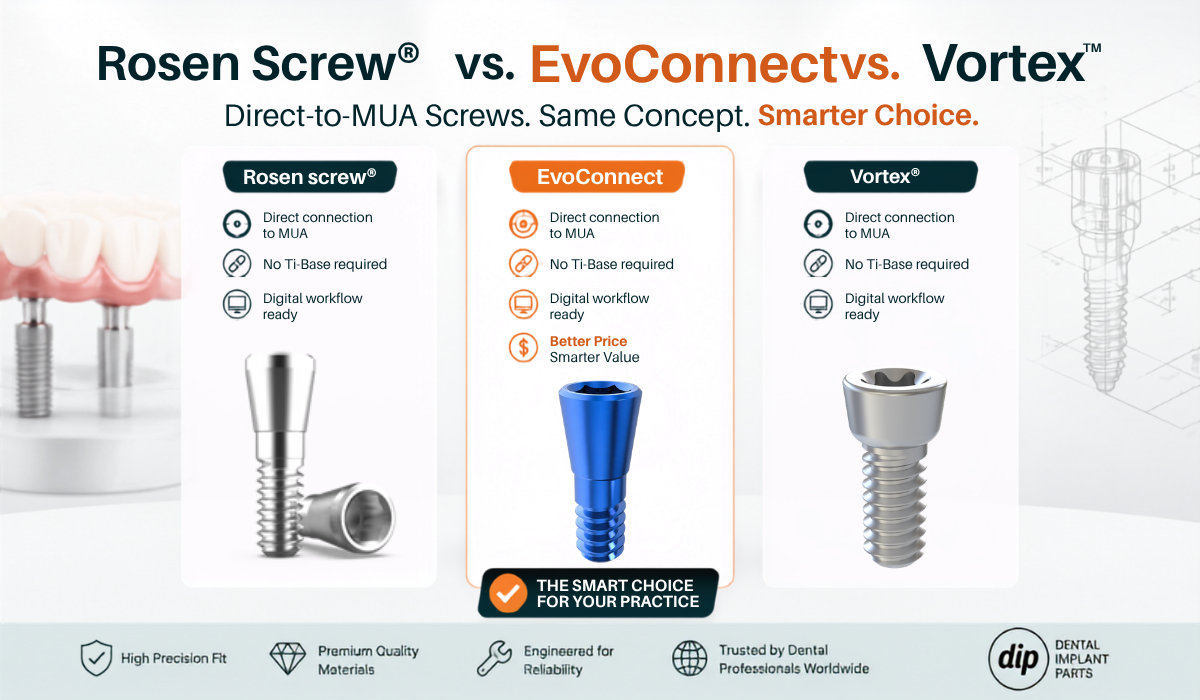
Three names increasingly associated with this workflow are Rosen Screw®, EvoConnect and Vortex™.
They share a similar fundamental restorative concept — but they are different products, from different brands, with differences in design, compatibility, drivers, available sizes and, importantly, price.
So how do they compare, and why is EvoConnect becoming an attractive alternative for laboratories and clinicians looking to reduce component costs?
What Is a Direct-to-MUA Prosthetic Screw?
In a conventional full-arch workflow, a Ti-Base may be bonded to the prosthesis and used as the interface between the restoration and the multi-unit abutment.
A direct-connection screw system takes a different approach.
The prosthesis can be designed to connect directly to the MUA, with the geometry of the prosthetic screw playing an important role in securing the restoration.
This can potentially simplify the restorative workflow by reducing the number of components and interfaces involved.
Depending on the specific system and case, potential advantages include:
- No traditional Ti-Base required
- Fewer restorative components
- No Ti-Base bonding step
- Simplified inventory
- Streamlined laboratory workflow
- Support for digital CAD/CAM restoration design
- Easier management of full-arch component costs
Both Rosen Screw and Vortex market direct-to-MUA solutions, while EvoConnect is designed around this same practical restorative approach.
Rosen Screw®: The Established Direct-Connection Concept
Rosen Screw® is one of the recognizable names associated with this type of restorative workflow.
Rosen Implant Solutions describes its system as allowing a direct connection to the MUA without requiring a Ti-Base, with options designed for different MUA connections and a digital library for restorative workflows.
For laboratories already working with Rosen Screw, the attraction is straightforward: reduce reliance on a separate Ti-Base while maintaining a screw-retained restoration.
The concept has therefore created demand for compatible components that can provide laboratories with the same type of workflow at a more competitive component cost.
And that is exactly where EvoConnect becomes interesting.
EvoConnect: Rosen-Compatible Workflow at a More Attractive Price
EvoConnect was developed for dental professionals who want a direct-to-MUA restorative solution without paying a premium price for every screw.
The principle is straightforward:
Keep the familiar direct-connection workflow. Reduce the component cost.
EvoConnect is designed as a Rosen Screw-compatible solution, making it particularly attractive for laboratories and clinicians already familiar with this restorative concept.
The EvoConnect range is available in:
- M1.4
- M1.6
- M1.7
This provides options for compatibility with numerous commonly used multi-unit abutment systems.
A digital library is also available to support modern CAD/CAM workflows.
For a laboratory restoring a large number of full-arch cases, the financial difference can become significant. A single restoration may require four, five, six or more prosthetic screws. Multiply that across dozens or hundreds of restorations and component pricing becomes an important operational consideration.
EvoConnect is therefore not about reinventing the direct-to-MUA concept.
It is about making that concept more economically accessible.
Vortex™ Screw: Another Approach to the Same Restorative Idea
Vortex™ also operates within the direct-to-MUA category.
Its 1.4 mm screw, for example, is marketed for direct MUA connection and uses a proprietary tapered-head design intended to engage the walls of the screw channel. Vortex also provides digital libraries for Exocad and 3Shape workflows.
Vortex offers multiple screw configurations, and its specifications vary depending on the particular product. For example, the 1.4 mm version uses the company's T5 driver, while other thread configurations are offered for selected implant/MUA systems.
So although Vortex, Rosen and EvoConnect belong to the same broad category of direct-to-MUA restorative solutions, they should not be treated as physically identical products.
That distinction is important.
Rosen Screw vs. EvoConnect vs. Vortex: What's the Difference?
The easiest way to understand the three systems is to separate the concept from the product.
| Rosen Screw® | EvoConnect | Vortex™ | |
|---|---|---|---|
| Direct-to-MUA concept | Yes | Yes | Yes |
| Designed to reduce need for traditional Ti-Base | Yes | Yes | Yes |
| Digital workflow support | Yes | Yes | Yes |
| Multiple connection options | Yes | Yes | Yes |
| Rosen-compatible | Original Rosen system | Yes | Separate system |
| EvoConnect sizes | — | M1.4 / M1.6 / M1.7 | — |
| Positioning | Established branded solution | Compatible, value-focused alternative | Proprietary branded solution |
| Price strategy | Premium branded product | Highly competitive | Premium branded product |
The key takeaway is simple:
The restorative idea is similar. The products themselves are not necessarily interchangeable.
Clinicians and technicians should always verify the exact thread, MUA connection, screw geometry, driver, digital library and recommended torque for the specific system being used.
Why Price Matters More Than It May Seem
A difference of a few dollars on a single dental component may seem insignificant.
Full-arch dentistry changes the calculation.
Consider a laboratory completing restorations that require six screws per case. At 20 cases per month, that is already 120 screws. At 100 cases, component consumption becomes substantial.
For high-volume laboratories, reducing the cost per screw without changing the basic restorative workflow can translate into meaningful annual savings.
This is one of the strongest arguments for EvoConnect.
Rather than asking:
"Which screw is cheapest?"
A better question is:
"Can I maintain the direct-to-MUA workflow and required compatibility while reducing my cost per restoration?"
For laboratories already using a Rosen-style workflow, EvoConnect is designed to provide exactly that alternative.
M1.4, M1.6 and M1.7: Why Thread Size Matters
Direct-connection screws are not universal.
The correct screw depends on the MUA system being restored.
EvoConnect is therefore available in M1.4, M1.6 and M1.7 configurations to cover a broader range of restorative requirements.
Before ordering, the laboratory or clinician should verify:
- MUA manufacturer and system
- Required thread diameter
- Screw length and geometry
- Required driver
- Recommended tightening torque
- Digital library compatibility
- Restorative material and design
Never select a prosthetic screw solely because another direct-to-MUA screw looks similar.
Compatibility must be confirmed for the specific restorative system.
Digital Workflows and Direct-to-MUA Restorations
The value of these screws extends beyond the physical component.
Modern full-arch restorations are increasingly designed digitally using platforms such as Exocad and 3Shape.
Digital libraries allow the technician to incorporate the appropriate screw channel and component geometry during the design stage rather than adapting the restoration afterward.
Rosen and Vortex both advertise digital workflow support, and EvoConnect also provides a digital library for integration into contemporary CAD/CAM workflows.
For a busy digital laboratory, this can be just as important as the screw itself.
Is EvoConnect an Original Rosen Screw® or Vortex™ Screw?
No.
This distinction should be completely clear.
EvoConnect is an independent compatible prosthetic screw solution. It is not manufactured by Rosen Implant Solutions or Vortex.
Its value proposition is different: provide dental laboratories and clinicians with access to the same general direct-to-MUA restorative concept, including Rosen-compatible workflows, while offering significantly more competitive pricing.
For buyers, that distinction is actually useful.
You are not paying for another label.
You are evaluating the component based on compatibility, workflow, manufacturing quality and cost per case.
Which Direct-to-MUA Screw Should You Choose?
There is no single answer for every laboratory or clinical case.
If you are already committed to a particular proprietary ecosystem, the original manufacturer's component may be the natural choice.
If your laboratory uses the Vortex workflow and its specific screw geometry and driver system, Vortex may make sense.
But if you are looking for a Rosen Screw-compatible direct-connection solution and component cost is an important consideration, EvoConnect offers a particularly attractive alternative.
The goal is not simply to buy a cheaper screw.
The goal is to maintain an efficient restorative workflow while reducing unnecessary component costs.
EvoConnect: A Smarter Cost per Full-Arch Case
Direct-to-MUA prosthetic screws are changing the way laboratories think about full-arch restorative components.
Rosen Screw®, EvoConnect and Vortex™ demonstrate different approaches within this growing category.
All three revolve around a similar fundamental idea:
simplify the connection between the restoration and the multi-unit abutment.
For dental professionals looking for an alternative to premium-priced components, EvoConnect provides a compelling combination of:
- Direct-to-MUA restorative workflow
- Rosen Screw-compatible options
- M1.4, M1.6 and M1.7 availability
- Digital workflow support
- Broad compatibility options
- Competitive pricing
- Volume purchasing opportunities
For high-volume laboratories in particular, the savings can become substantial without requiring a fundamental change to the restorative concept.
Same concept. Familiar workflow. Smarter component cost.
Explore EvoConnect Direct Connection Screws at dip dental™.
Frequently Asked Questions
What is the difference between Rosen Screw®, EvoConnect and Vortex™?
All three are associated with direct-to-MUA restorative workflows, but they are different products from different brands. Their screw geometry, thread options, drivers, torque specifications and compatibility can differ.
Is EvoConnect compatible with Rosen Screw® workflows?
EvoConnect is designed as a Rosen Screw-compatible direct-connection solution. The exact thread and MUA compatibility should always be verified before use.
Is EvoConnect the same product as Rosen Screw®?
No. EvoConnect is an independent compatible product. It is not manufactured or endorsed by Rosen Implant Solutions.
Is EvoConnect the same as Vortex™?
No. EvoConnect and Vortex are different products. They share the broader direct-to-MUA restorative concept but have their own designs, specifications and compatibility requirements.
What EvoConnect screw sizes are available?
EvoConnect is available in M1.4, M1.6 and M1.7 options for compatibility with different MUA systems.
Why consider EvoConnect instead of a premium branded screw?
For clinics and laboratories using multiple screws per full-arch restoration, component costs can accumulate quickly. EvoConnect is positioned as a more competitively priced option while maintaining the direct-to-MUA workflow.