Una mirada clínica al adhesivo tisular oral, la estabilización de tejidos blandos y el cierre quirúrgico simplificado
En cirugía oral, procedimientos periodontales, implantología y manejo de tejidos blandos, el éxito clínico a menudo depende de algo más que la técnica quirúrgica en sí. El cierre, la estabilización, la hemostasia, la comodidad del paciente y la protección del sitio quirúrgico pueden influir en el resultado final de la curación.
Tradicionalmente, las suturas han sido el método estándar para aproximar los tejidos blandos orales. Siguen siendo esenciales en muchos procedimientos y a menudo son la elección correcta. Sin embargo, en situaciones clínicas seleccionadas, un adhesivo tisular oral quirúrgico puede apoyar el flujo de trabajo al ayudar a estabilizar los tejidos, reducir el número de suturas necesarias y proteger el sitio quirúrgico.
Aquí es donde Periacryl 90 HV Adhesivo Quirúrgico de Tejido Oral de Alta Viscosidad se vuelve especialmente relevante.
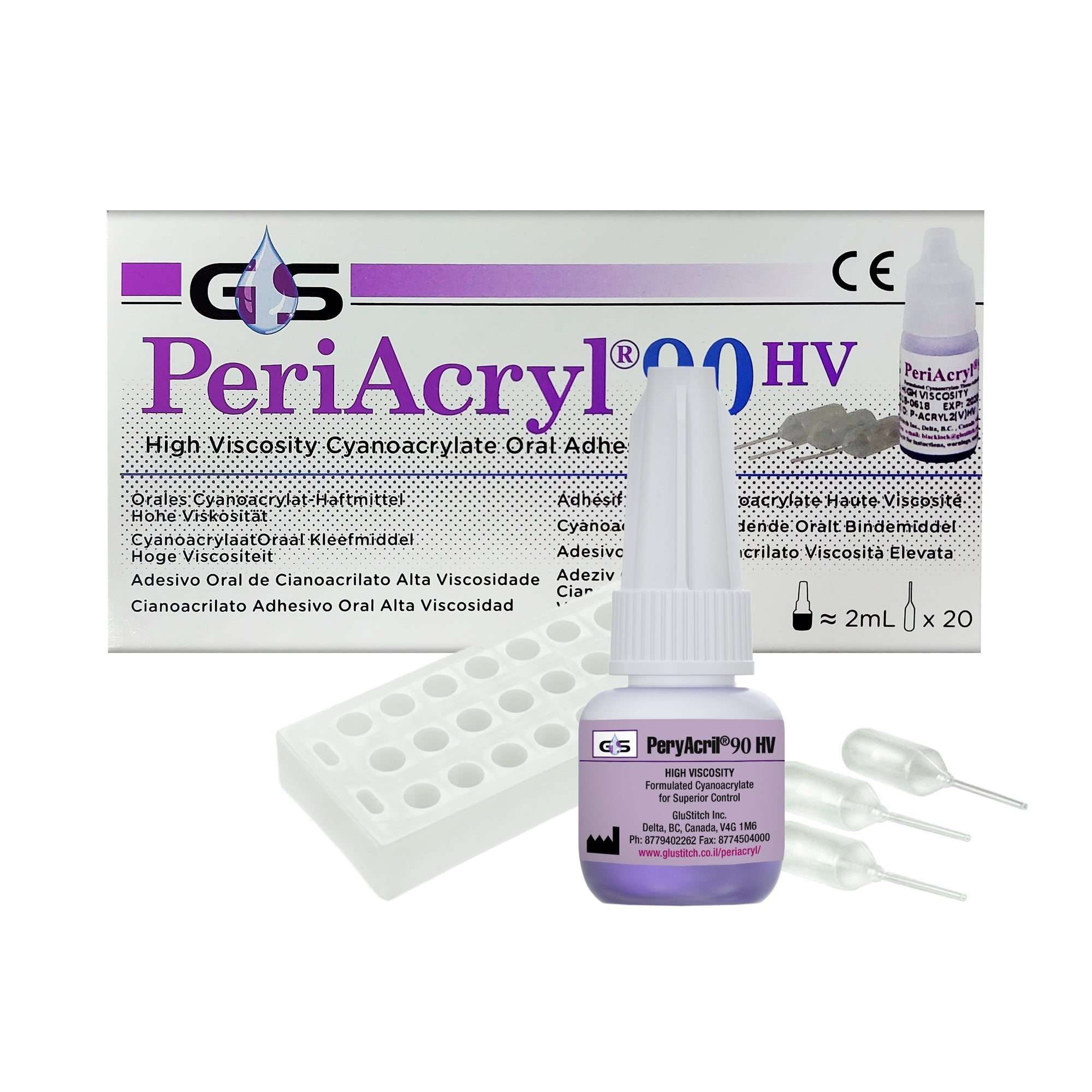
Diseñado específicamente para su uso en la cavidad oral, Periacryl 90 HV es un adhesivo tisular quirúrgico a base de acrílico formulado con una combinación de adhesivos de butil y octil cianoacrilato. Su propósito es unir tejidos blandos, crear un apósito protector flexible y ayudar a mantener la estabilidad del sitio quirúrgico durante la fase inicial de cicatrización.
Para los clínicos que buscan un adhesivo tisular oral controlado y de alta viscosidad, Periacryl 90 HV ofrece una opción práctica para una variedad de procedimientos de tejidos blandos.
¿Qué es Periacryl 90 HV?
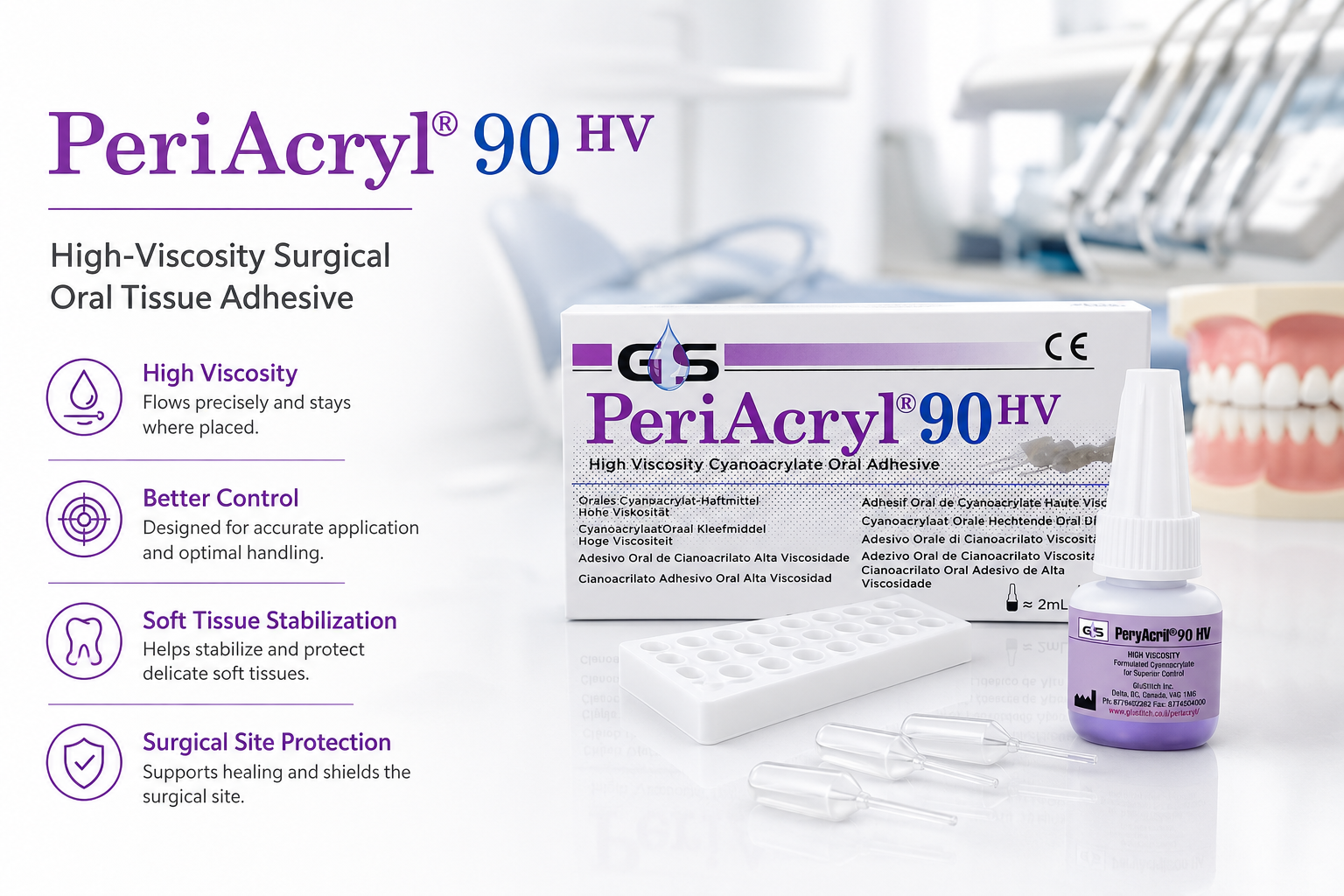
Periacryl 90 HV es un adhesivo tisular oral quirúrgico de alta viscosidad diseñado para unir tejidos blandos dentro de la boca. A diferencia de los adhesivos de baja viscosidad que pueden correrse o esparcirse demasiado rápido, la formulación HV está diseñada para mejorar el control durante la aplicación.
Según las especificaciones del producto, Periacryl 90 HV es 9 veces más viscoso que la formulación original de PeriAcryl 90, manteniendo las mismas características de resistencia y durabilidad asociadas con la línea de productos.
Esa mayor viscosidad puede ser clínicamente importante. En la cavidad oral, la humedad, el movimiento tisular, la saliva, el sangrado y el acceso limitado pueden dificultar la precisión. Un adhesivo más espeso permite al clínico colocar el material con mayor precisión y evitar su propagación innecesaria a áreas donde no se necesita.
Explore el producto aquí:
Periacryl 90 HV Adhesivo Quirúrgico de Tejido Oral de Alta Viscosidad
Por qué la alta viscosidad es importante en la cirugía oral
El control es uno de los mayores desafíos al usar cualquier adhesivo en la boca.
Los sitios quirúrgicos orales no son secos, estáticos o planos. Están expuestos a sangre, saliva, tejidos en movimiento y superficies anatómicas complejas. Un adhesivo tisular que fluye con demasiada facilidad puede ser más difícil de controlar, especialmente en áreas posteriores, alrededor de implantes, en sitios donantes palatinos o cerca de márgenes delicados de tejidos blandos.
La fórmula de alta viscosidad de Periacryl 90 HV está diseñada para permitir una colocación más controlada. Esto puede ayudar a los clínicos a aplicar una capa delgada y dirigida de adhesivo exactamente donde se necesita.
En términos prácticos, un mejor control puede ayudar con:
-
Aplicación más precisa
-
Menos dispersión no deseada
-
Manejo más fácil en áreas de difícil acceso
-
Mejor visibilidad al usar la versión violeta
-
Cobertura más predecible del sitio quirúrgico
-
Un flujo de trabajo más limpio durante los procedimientos de tejidos blandos
Para muchos clínicos, el valor de un adhesivo quirúrgico para tejidos orales no reside solo en su capacidad de adhesión, sino también en lo fácil y predecible que es usarlo durante un procedimiento real.
Usos clínicos del adhesivo quirúrgico de tejidos orales
Los adhesivos tisulares a base de cianoacrilato se han discutido en la literatura dental y de cirugía oral como alternativas o complementos a las suturas en casos seleccionados. Se han utilizado en heridas orales, procedimientos periodontales, cirugía mucogingival, protección de sitios donantes y estabilización de tejidos blandos.
Periacryl 90 HV puede considerarse en varios escenarios clínicos.
1. Reducción del número de suturas
Una de las razones más comunes por las que los clínicos utilizan adhesivos tisulares orales es para reducir el número de suturas necesarias en los procedimientos de tejidos blandos.
Las suturas son fiables, pero también aumentan el tiempo en el sillón, pueden contribuir a la irritación local y a menudo requieren su retirada. En casos seleccionados, un adhesivo puede ayudar a aproximar o estabilizar los tejidos blandos y puede reducir la necesidad de suturas adicionales.
Esto no significa que las suturas ya no sean necesarias. Más bien, Periacryl 90 HV puede usarse como parte de una estrategia de cierre quirúrgico más amplia cuando la situación clínica lo permite.
2. Estabilización gingival y de tejidos blandos
La estabilidad de los tejidos blandos es fundamental en muchos procedimientos periodontales y relacionados con implantes. El movimiento del tejido durante la fase inicial de cicatrización puede comprometer el sitio quirúrgico, alterar el área del injerto o aumentar la incomodidad del paciente.
Periacryl 90 HV crea un apósito fuerte y flexible que ayuda a estabilizar el área quirúrgica. Esto lo hace relevante para procedimientos que involucran tejidos gingivales, injertos de tejidos blandos y manejo de tejidos blandos relacionados con implantes.
3. Apósito protector después de procedimientos quirúrgicos
Después de la cirugía oral, proteger la superficie de la herida puede favorecer el entorno de cicatrización.
Una fina capa de adhesivo tisular quirúrgico puede actuar como apósito protector sobre el sitio. Esto puede ser útil en áreas donde la irritación mecánica de la lengua, los alimentos o el movimiento oral pueden alterar el tejido en cicatrización.
En procedimientos periodontales y de tejidos blandos, la protección de la superficie de la herida es a menudo una parte importante del manejo postoperatorio.
4. Hemostasia y control de hemorragias postoperatorias
El control del sangrado es una consideración importante en la cirugía oral, especialmente en pacientes que toman medicación anticoagulante o en procedimientos que involucran tejidos blandos altamente vascularizados.
Se describe que Periacryl 90 HV ayuda a detener el sangrado de forma rápida y eficaz. En algunas situaciones clínicas, el adhesivo tisular puede utilizarse junto con suturas para ayudar a estabilizar el área y favorecer la hemostasia.
Como siempre, el control del sangrado debe gestionarse de acuerdo con el criterio del clínico, el historial médico del paciente, el estado anticoagulante y los protocolos quirúrgicos apropiados.
5. Manejo de laceraciones de tejidos blandos
La descripción del producto también señala un posible uso en la reparación de cortes profundos en la lengua sin puntos. En ciertas laceraciones de tejidos blandos, un adhesivo tisular puede ayudar a cerrar y proteger el área más rápidamente que la sutura convencional.
Sin embargo, la profundidad de la herida, la contaminación, la tensión tisular, la edad del paciente, la cooperación y la ubicación anatómica siempre deben considerarse antes de elegir el cierre con adhesivo.
Violeta o transparente: elección de la versión correcta
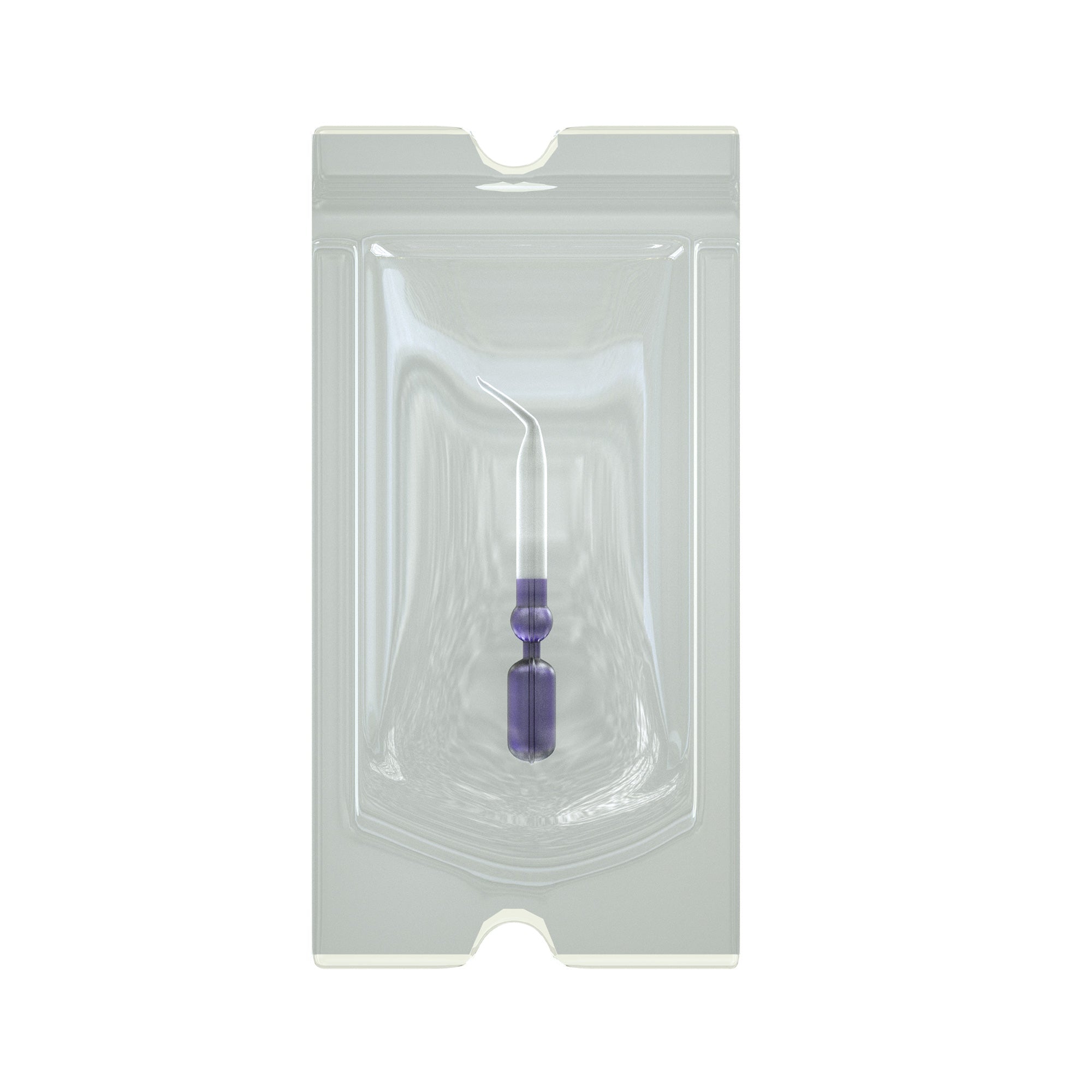
Periacryl 90 HV está disponible en opciones violeta y transparente.
La versión violeta puede ser útil cuando se necesita una mejor identificación visual. Esto permite al clínico ver exactamente dónde se ha colocado el adhesivo, lo que puede ser útil durante procedimientos quirúrgicos o en áreas posteriores.
La versión transparente puede preferirse en áreas más estéticas donde la visibilidad del material es menos deseable.
Esto ofrece a los clínicos flexibilidad en función del procedimiento, las necesidades de visibilidad y el área de tratamiento.
Características del producto
Periacryl 90 HV incluye varias características prácticas para uso clínico:
-
Fórmula de alta viscosidad para un mejor control
-
Tiempo de autocurado de 30 segundos
-
Disponible en opciones violeta o transparente
-
Diseñado para la unión de tejidos blandos en la cavidad oral
-
Crea un apósito fuerte y flexible
-
Aplicación fácil de usar
-
Diseño de botella especial para ayudar a mantener el producto limpio
-
Biocompatible
-
Antibacterial
-
Libre de toxinas y sustancias peligrosas
-
Ayuda a detener el sangrado de forma rápida y eficaz
Estas características lo convierten en un producto útil para los clínicos que desean un adhesivo quirúrgico práctico para procedimientos de tejidos blandos.
Opciones disponibles
Periacryl 90 HV está disponible en múltiples configuraciones, lo que permite a los clínicos elegir el formato que mejor se adapte a su flujo de trabajo:
-
2 ml de pegamento violeta + 20 pipetas + bandeja
-
2 ml de pegamento transparente + 20 pipetas + bandeja
-
10 unidades de 0,2 ml de pegamento violeta para un solo uso
-
5 ml de pegamento violeta + 50 pipetas + bandeja
El formato de un solo uso puede ser útil para los clínicos que prefieren la aplicación pre-dosificada y un menor manejo. Las botellas más grandes pueden ser más adecuadas para las clínicas que utilizan adhesivo quirúrgico con frecuencia.

Periacryl 90 HV en el flujo de trabajo dental moderno
La cirugía dental moderna se centra cada vez más en la eficiencia, la precisión y la comodidad del paciente. Los productos que simplifican el flujo de trabajo clínico y apoyan un manejo predecible de los tejidos blandos pueden añadir valor a la práctica.
Periacryl 90 HV encaja en este enfoque al ofrecer una colocación controlada del adhesivo, un curado rápido y la estabilización de los tejidos blandos en casos seleccionados.
No sustituye el juicio clínico, el diseño adecuado del colgajo, el manejo atraumático o la sutura cuando se requieren puntos. En cambio, es una herramienta adicional que puede ayudar a los clínicos a manejar los tejidos blandos orales de manera más eficiente.
Conclusión final
El cierre quirúrgico es una parte fundamental de la cirugía oral, el tratamiento periodontal y el manejo de los tejidos blandos relacionados con implantes.
Si bien las suturas siguen siendo esenciales, los adhesivos tisulares orales de alta viscosidad pueden apoyar flujos de trabajo clínicos seleccionados al ayudar a estabilizar los tejidos, proteger el sitio quirúrgico, reducir la necesidad de suturas y ayudar con la hemostasia.
Periacryl 90 HV Adhesivo Quirúrgico de Tejido Oral de Alta Viscosidad ofrece una solución controlada, práctica y clínicamente relevante para los profesionales dentales que buscan un adhesivo tisular oral confiable.
Explore el producto aquí:
Periacryl 90 HV Adhesivo Quirúrgico de Tejido Oral de Alta Viscosidad