
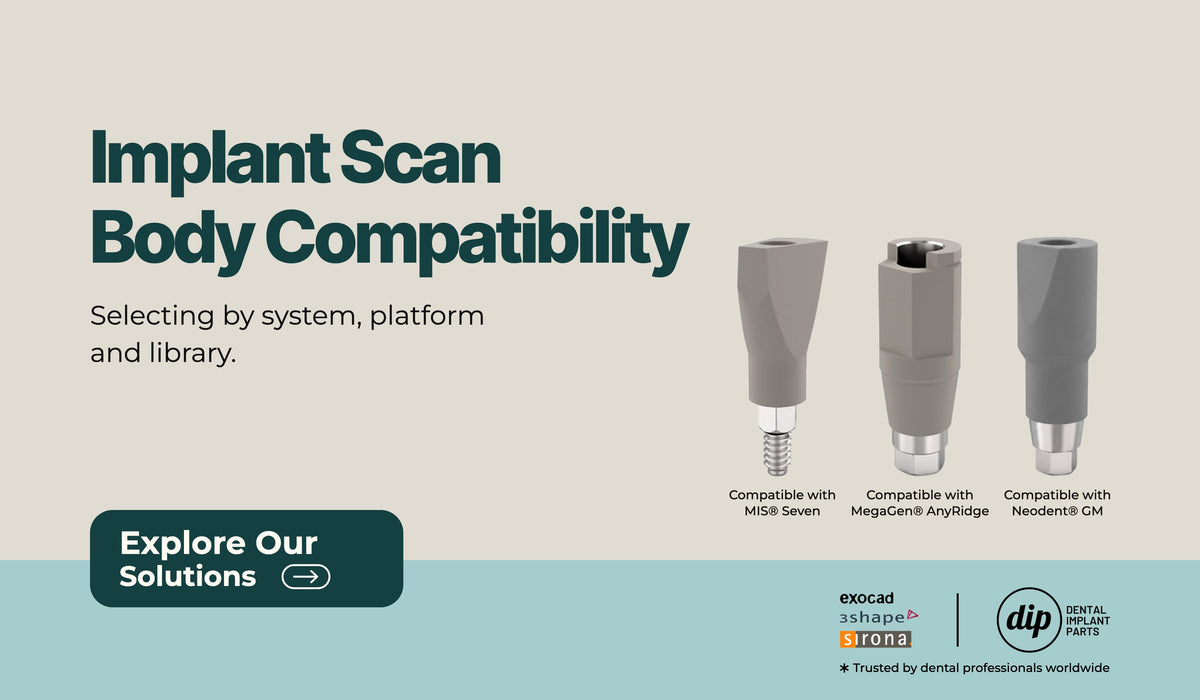
The scan body records the position and orientation of the implant so the restoration can be designed in software without a conventional impression. The CAD program can only place the implant correctly if the scan body matches two things at once: the connection in the mouth and the library file on the computer.
A systematic review in the Journal of Prosthetic Dentistry described intraoral scan bodies as complex implant-position transfer devices with an essential role in the digital workflow, and noted that their design varies widely (Mizumoto and Yilmaz, 2018).
For a laboratory restoring several implant systems, that variation is the practical problem. This guide covers selection by system, platform and library across the systems for which dip dental™ supplies compatible scan bodies.
What the scan body has to get right
Three jobs sit on one part. The lower section has to seat on the connection in a fixed, non-rotational position, the upper section has to give the scanner a clean geometry, and the whole shape has to match a library file, because the CAD software locates the implant by matching the scan to that file.
An in vitro study found that both scan body geometry and edits to the library file affected how accurately the software matched the scan (Lee et al., 2026).
A 2023 review of intraoral implant scanning also listed scan body design, including material, geometry and retention, among the operator-related factors that can affect accuracy, alongside ambient lighting and scanning pattern (Revilla-León et al., 2023).
The three things that decide which scan body fits
The implant connection and platform diameter
The connection comes first, then the platform. Several systems are split into platforms that take different scan bodies: in the dip dental™ range, scan bodies compatible with Straumann® Bone Level CrossFit® (NC and RC), Osstem® TS / Hiossen® ET (Mini and Regular) and the Nobel Biocare® conical connection (NP and RP) are listed separately by platform.
Other connections cover a wide diameter range on one platform: Ø3.5 to Ø7.0 mm for the scan bodies compatible with Neodent® GM Grand Morse®, and Ø3.5 to Ø8.0 mm for MegaGen® AnyRidge®. The implant diameter alone is therefore not enough. The record that matters is system, connection and platform together.
Implant level or multi-unit level
An implant-level scan body seats in the implant connection; a multi-unit scan body seats on a multi-unit abutment (MUA), so the restoration is designed at abutment level.
At multi-unit level, the abutment screw thread is part of the specification. The MIS® compatible multi-unit scan body is specified with an M1.6 thread and is supplied with its screw. For the dip dental™ multi-unit abutments, PEEK scan post bodies are listed separately for the M1.4, M1.6 and M1.7 connections.
The CAD/CAM library that matches the part
Before ordering, confirm that the library for that exact scan body is available in the laboratory's design software. For the dip dental™ CAD/CAM scan bodies compatible with Osstem® TS / Hiossen® ET, the product page offers a free library download with STL geometry files and the config.xml for exocad® and 3Shape®. The scan bodies in the Sirona® CEREC compatible range are listed as also usable in exocad® and 3Shape® workflows with the matching library.
For how libraries are structured and loaded, see CAD/CAM libraries for dental implants explained.
Scan body options by implant system
Every scan body compatible with each system in the current dip dental™ catalog, with the lowest volume price ("as low as") from each product page:
Neodent® GM Grand Morse®
Platforms listed: RP, Ø3.5 to Ø7.0 mm
- CAD/CAM scan body (ref. PN 108.207) (as low as $18.70)
- Sirona® CEREC scan bodies: straight (as low as $32.30), 20° angled, 20° angled anterior (as low as $63.75 each)
- Multi-unit CAD/CAM scan body (as low as $16.15)
Osstem® TS / Hiossen® ET
Platforms listed: Mini NP Ø3.0 to Ø3.5 mm; Regular RP Ø4.0 to Ø7.0 mm
- CAD/CAM scan body: Mini, Regular (as low as $18.70)
- PEEK scan post for Ti-Base (as low as $18.70)
- Sirona® CEREC RP scan bodies: straight (as low as $32.30), 20° angled, 20° angled anterior (as low as $63.75 each)
- Sirona® CEREC Mini NP scan bodies: straight (as low as $32.30), 20° angled, 20° angled anterior (as low as $63.75 each)
- Multi-unit CAD/CAM scan body (as low as $16.15)
MegaGen® AnyRidge®
Platforms listed: Ø3.5 to Ø8.0 mm
- Scan post, 9 mm and 13 mm (as low as $18.70)
- Sirona® CEREC scan bodies: straight (as low as $32.30), 20° angled, 20° angled anterior (as low as $63.75 each)
- Multi-unit CAD/CAM scan body (as low as $16.15)
MegaGen® AnyOne®
Platforms listed: RP, Ø3.9 to Ø8.3 mm
- Sirona® CEREC scan bodies: straight (as low as $32.30), 20° angled, 20° angled anterior (as low as $63.75 each)
MIS® Seven
Platforms listed: Standard Platform (SP); MIS® multi-unit
- SP scan body (scan post) (as low as $18.70)
- Multi-unit scan body, M1.6, with screw (as low as $16.15)
Straumann® Bone Level
Platforms listed: CrossFit® NC Ø3.3 mm; RC Ø4.1 to Ø4.8 mm
- Sirona® CEREC NC scan bodies: straight (as low as $32.30), 20° angled, 20° angled anterior (as low as $63.75 each)
- Sirona® CEREC RC scan bodies: straight (as low as $32.30), 20° angled, 20° angled anterior (as low as $63.75 each)
Dentium® SuperLine™ / Implantium®
Platforms listed: RP; SuperLine™ Ø3.6 to Ø7.0 mm, Implantium® Ø3.6 to Ø5.0 mm
- Sirona® CEREC scan bodies: straight (as low as $32.30), 20° angled, 20° angled anterior (as low as $63.75 each)
Nobel Biocare® NobelActive® / NobelParallel™
Platforms listed: Conical NP Ø3.5 mm; RP Ø4.3 to Ø5.0 mm
- Sirona® CEREC NP scan bodies: straight (as low as $32.30), 20° angled, 20° angled anterior (as low as $63.75 each)
- Sirona® CEREC RP scan bodies: straight (as low as $32.30), 20° angled, 20° angled anterior (as low as $63.75 each)
- Multi-unit CAD/CAM scan body (as low as $16.15)
DIP internal hex
Platforms listed: Ø2.42 mm hex (RP 3.5 platform); Ø2.00 mm narrow hex
- Titanium scan post Ø3.7 mm (as low as $11.90)
- PEEK scan post Ø3.75 mm (as low as $15.30)
- Narrow titanium scan post Ø3.0 mm (Ø2.00 mm hex) (as low as $11.90)
- Sirona® CEREC RP 3.5 scan bodies: straight (as low as $32.30), 20° angled, 20° angled anterior (as low as $63.75 each)
DIP conical connection
Platforms listed: NP Ø3.5 mm; RP Ø4.3 to Ø5.0 mm
- Titanium scan post NP (as low as $15.30)
- Titanium scan post RP (as low as $15.30)
dip dental™ multi-unit abutments
Platforms listed: M1.4, M1.6 and M1.7 connections
- PEEK scan post body M1.4 (as low as $18.70)
- PEEK scan post body M1.6 (as low as $18.70)
- PEEK scan post body M1.7 (as low as $18.70)
Neodent® GM Grand Morse®
The implant-level CAD/CAM scan body is listed under reference PN 108.207, in titanium grade 5 (Ti-6Al-4V ELI) with an aluminum oxide sandblasted surface. The Neodent-specific workflow is covered in the Neodent® scan body guide and the Neodent® digital workflow article.
Osstem® TS and Hiossen® ET
The Mini and Regular CAD/CAM scan bodies pair a titanium grade 5 base with a radiolucent PEEK scan post and a titanium fixation screw. The multi-unit CAD/CAM scan body covers the Osstem® multi-unit system.

MegaGen® AnyRidge® and AnyOne®
The AnyRidge® scan post comes in 9 mm and 13 mm lengths at Ø4.0 mm with an M1.8 fixation screw, and its product page states that the same library as MegaGen® AnyRidge® can be used. AnyOne® is covered by the Sirona® CEREC compatible range.
MIS® Seven and MIS® multi-unit
The SP scan body compatible with MIS® Seven is titanium grade 5 with PEEK and is listed as compatible with the MIS® CAD/CAM library. The multi-unit version is sandblasted titanium with an M1.6 thread, screw included.
Straumann® Bone Level NC and RC
NC and RC are separate products in the Sirona® CEREC compatible range for the BL and BLT CrossFit® connections, so confirm the platform from the implant record before ordering.
Dentium® SuperLine™ and Implantium®
The Sirona® CEREC compatible scan bodies are listed for SuperLine™ I/II and Implantium® on the RP conical connection.
Nobel Biocare® NobelActive® and NobelParallel™
The conical connection listings name NobelActive®, NobelParallel™ CC and NobelReplace® CC, and the multi-unit CAD/CAM scan body is listed for the Nobel® multi-unit system.
Internal hex and conical connection platforms
Titanium and PEEK scan posts are listed for the DIP internal hex (Ø2.42 mm, with a narrow Ø2.00 mm version), and titanium scan posts for the DIP conical connection in NP and RP.
Straight, angled and anterior angled scan bodies
In the Sirona® CEREC compatible range, each connection has three scan body types, each matched to a specific Ti-Base.
- Straight: gingiva heights of 0.5 mm, 1.5 mm and 3.0 mm, coded on top by 1, 2 or 3 slots, the same code used on the straight Ti-Bases, so the scan tells the software which height to place.
- 20° angled: for implants placed at an angle where a straight screw channel would exit through the facial or incisal surface. Type A and Type B index the channel differently, giving 8 screw channel orientations between them. Gingiva height 1.5 mm, collar 3.0 mm.
- 20° angled anterior: for thin anterior tissue, paired with the anterior angled Ti-Base (0.7 mm gingiva height, gold-colored base), also in Type A and Type B.

All three share a Ø4.5 mm scan area. The choice is restorative: which Ti-Base the design uses, and where the access hole needs to exit.

Chairside CEREC workflows and the Sirona® CEREC compatible range
The Sirona® CEREC compatible scan body collection currently lists 33 products: straight, 20° angled and 20° angled anterior versions for 11 platforms across Neodent® GM, MegaGen® AnyRidge® and AnyOne®, Osstem® TS / Hiossen® ET, Dentium®, Straumann® Bone Level, Nobel Biocare® and the DIP internal hex.
Each scan body records the implant position for design on the matching Sirona® CEREC Ti-Base, with a Ti-6Al-4V ELI base and a PEEK scan top described on the product pages as a matte polymer that reads cleanly with both intraoral and desktop lab scanners.
Titanium and PEEK scan bodies in practice
Most scan bodies in the range combine a titanium base with a PEEK scan top, including the Osstem® TS / Hiossen® ET CAD/CAM scan bodies, which are listed as autoclavable and reusable. The Neodent® GM implant-level and multi-unit CAD/CAM scan bodies are sandblasted titanium grade 5.
The published evidence does not name one best material. The 2023 review concluded that the optimal design is unclear and may vary with the intraoral scanner, and that polymer scan bodies can wear with repeated reuse and sterilization, which is why it preferred metallic designs (Revilla-León et al., 2023).
An in vitro comparison on four intraoral scanners found higher trueness and precision with PEEK than titanium, and significant differences between the scanners (Soltan et al., 2025).
Reuse deserves its own record. With scan bodies sterilized at 134 °C between scans, deviation increased significantly over 10 cycles in all three groups of an in vitro study, and the authors recommended limiting reuse (Aktas et al., 2025). Logging autoclave cycles per scan body is a simple way to act on that.
A short ordering checklist
- Confirm the implant system and connection from the surgical record or the implant label.
- Confirm the platform (NP, RP, NC or RC) and the diameter range it covers.
- Decide the restorative level: an implant-level scan body, or a multi-unit scan body matched to the MUA thread, for example M1.4, M1.6 or M1.7.
- Check that the library for that exact scan body is installed in the design software.
- For Sirona® CEREC Ti-Base cases, match the gingiva height, the scan body type and, for an angled channel, Type A or Type B.
- Record the material and the number of sterilization cycles for every reusable scan body.
The full digital range is in the Digital Implant Dentistry collection. For a wider comparison of original and compatible parts, see OEM vs compatible dental implant components.
Frequently Asked Questions
How do I know which scan body fits my implant?
Match three details: the implant system and connection, the platform (for example NC or RC, NP or RP), and whether the restoration is designed at implant level or on a multi-unit abutment. The dip dental™ product titles name all three, so they can be checked line by line against the implant record.
Can one scan body be used across several implant systems?
At multi-unit level, yes: the dip dental™ multi-unit CAD/CAM scan body is listed as compatible with the Osstem®, Hiossen®, Neodent®, Nobel® and MegaGen AnyRidge® multi-unit systems. At implant level, each scan body in the range is listed for one specific connection and platform.
What is the difference between a scan body and a scan post?
In the dip dental™ catalog the two terms describe the same part, and product titles use them together, for example "Scan Body / Scan Post". The one distinct item is the PEEK scan post for Osstem® TS / Hiossen® ET, which is used to scan a dip dental™ Ti-Base restoration in place of a full titanium scan body.
Do angled scan bodies change the scan accuracy?
No accuracy claim is made for them: the stated purpose of the 20° angled scan body, per its product page, is to let the software place the 20° angled Ti-Base with the correct screw channel orientation. The one study cited here that tested angulation looked at implant angulation, not an angled scan body design (Soltan et al., 2025), and the 2023 review lists implant angulation among the patient-related factors that can affect implant scans.
Does a multi-unit scan body replace the implant-level scan body?
No. The two record different interfaces: an implant-level scan body records the implant connection, and a multi-unit scan body records the position of a multi-unit abutment already in place. A mixed case may need both.
Whatever the system, verify the implant identification before ordering, and confirm the library is in place before the scan.
Brand names are trademarks of their respective owners and are used only to describe compatibility. dip dental™ is not affiliated with, endorsed by, or a distributor for any of them.


