Conexión cónica vs. Implantes de hexágono interno: lo que realmente importa en la etapa protésica
El debate entre la conexión cónica y el hexágono interno resurge de manera confiable en cada programa de residencia, en cada club de estudio de implantes y cada vez que un nuevo sistema entra en el mercado. La mayoría de los profesionales han revisado la literatura, analizado los metanálisis y asistido a las presentaciones de ventas. Sin embargo, la pregunta clínica sigue siendo genuinamente incierta para muchos: ¿qué geometría de conexión debe especificarse y por qué es importante desde el punto de vista protésico? Este artículo va más allá de la teoría biomecánica y se centra en los puntos de decisión que realmente afectan los resultados: estabilidad ósea marginal, integridad del tornillo del pilar, manejo del perfil de emergencia y las realidades prácticas del flujo de trabajo multisistema. Ya sea que coloque predominantemente un sistema o maneje una base de referencia mixta, comprender estas diferencias a nivel mecánico cambia la forma en que selecciona y secuencia los componentes.

La diferencia mecánica que impulsa los resultados clínicos
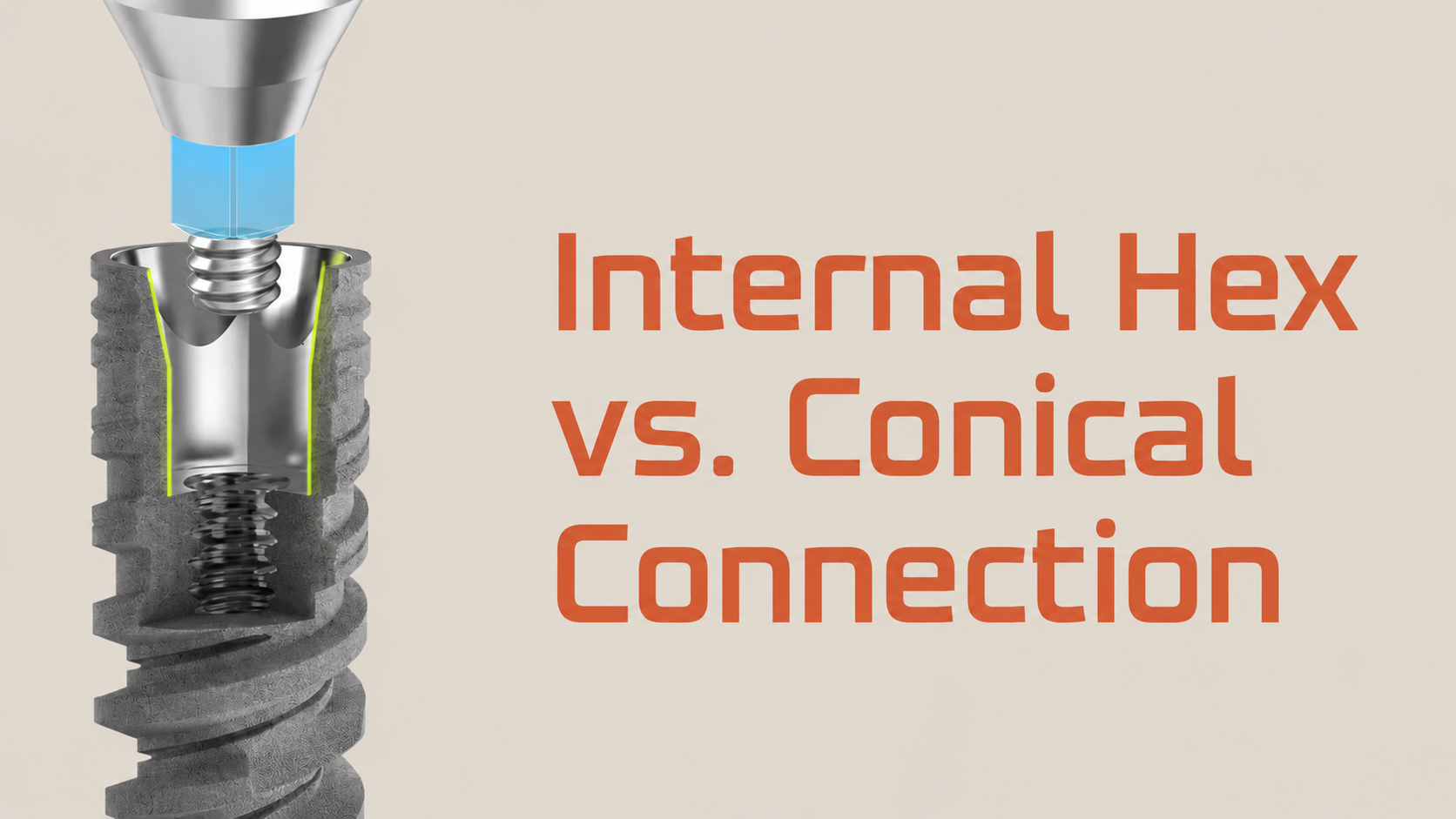
La conexión de hexágono interno introdujo una geometría antirrotacional estandarizada en la década de 1980 que hizo posible la compatibilidad entre fabricantes, una verdadera ventaja práctica que estableció su dominio global por base instalada. El hueco hexagonal (típicamente de Ø2,42 mm en plataforma estándar, Ø2,00 mm en plataforma estrecha) indexa el pilar, resiste la transmisión de torque y proporciona una referencia de asentamiento reproducible. La interfaz se basa principalmente en la fuerza de apriete del tornillo para mantener la estabilidad de la unión, con la característica hexagonal controlando la rotación.
La conexión cónica, la variante de cono Morse, opera con un principio mecánico fundamentalmente diferente. En lugar de depender únicamente de la indexación geométrica, crea un ajuste de interferencia por fricción entre el poste cónico del pilar y el orificio del implante. El ángulo del cono (comúnmente de 1,5° a 12° según el sistema) determina el grado de soldadura en frío que se produce bajo el torque de asentamiento. En ángulos de cono más estrechos, por debajo de 5°, el efecto de autobloqueo se vuelve pronunciado: la conexión resiste la extracción por fricción en lugar de solo por la tensión del tornillo. Esto tiene consecuencias directas sobre el micromovimiento en la interfaz, la formación de microbrechas y la respuesta biológica periimplantaria resultante.
La distinción que más importa desde el punto de vista protésico es el tamaño y el comportamiento de la microbrecha implante-pilar bajo carga funcional. En las conexiones de hexágono interno, una microbrecha de 5 a 10 μm está rutinariamente presente en la interfaz incluso con tolerancias de mecanizado precisas. La colonización bacteriana de este espacio, y el infiltrado inflamatorio resultante, está bien documentada en estudios histológicos. Las conexiones cónicas, cuando se asientan correctamente, reducen sustancialmente esta brecha y desplazan la unión apicalmente o la eliminan estructuralmente, lo que tiene implicaciones directas para el mantenimiento del hueso crestal.

Estabilidad ósea crestal: lo que realmente muestran los datos de la revisión sistemática
Una revisión sistemática de 2018 en el International Journal of Oral and Maxillofacial Implants informó una pérdida ósea marginal media a los tres años de aproximadamente 0,26 mm para los implantes de conexión cónica frente a 0,61 mm para los de hexágono interno, una diferencia estadísticamente significativa. Más importante aún, la varianza fue menor en el grupo cónico, menos casos atípicos con reabsorción crestal acelerada. Aquí es donde el argumento clínico a favor de las conexiones cónicas es más sólido: no es que todos los casos de hexágono interno fracasen, sino que la distribución de los resultados es más predecible con una interfaz sellada.
El cambio de plataforma, descrito originalmente en el contexto de los implantes de hexágono interno, mitiga parcialmente la pérdida ósea asociada a la microbrecha al reposicionar el infiltrado inflamatorio medialmente lejos del hueso crestal. Sin embargo, las conexiones cónicas han reemplazado en gran medida al cambio de plataforma como el principal mecanismo de preservación ósea crestal en el diseño de implantes contemporáneos, particularmente en configuraciones a nivel de tejido blando y en sitios posteriores donde se utiliza la colocación subcrestal para maximizar la anchura biológica.
Para el profesional que maneja casos estéticos anteriores o pacientes con biotipo delgado, esta diferencia no es académica. Una preservación ósea marginal adicional de 0,3 a 0,4 mm durante tres años se traduce directamente en estabilidad de los tejidos blandos y mantenimiento del perfil de emergencia, parámetros que definen los resultados restaurativos anteriores a largo plazo.
Aflojamiento del tornillo del pilar y retención del par
El aflojamiento del tornillo sigue siendo la complicación mecánica más común en la prostodoncia implantológica, con tasas reportadas del 6-20% en cinco años para restauraciones de un solo diente, dependiendo del sistema y las condiciones de carga. La biomecánica aquí es bien conocida: bajo carga oclusal cíclica, la unión del tornillo experimenta microasentamientos que reducen progresivamente la precarga, lo que finalmente permite el micromovimiento y el ciclo de fatiga mecánica que precede a la fractura.
Las conexiones cónicas mejoran la retención del par a través de dos mecanismos. Primero, el ajuste de interferencia por fricción complementa la precarga del tornillo para mantener la estabilidad de la unión; el cono Morse actúa como un elemento de retención secundario que el tornillo por sí solo no proporciona en un sistema puramente hexagonal. Segundo, la reducción del micromovimiento en la interfaz disminuye el microasentamiento que degrada la precarga con el tiempo. Los estudios clínicos que comparan las tasas de aflojamiento de tornillos favorecen constantemente las conexiones cónicas, particularmente en escenarios de un solo diente posterior y de corta extensión donde las fuerzas de voladizo y la carga fuera del eje son mayores.
Los sistemas de hexágono interno no son inherentemente inferiores aquí, pero requieren más atención a la consistencia del protocolo de torque. Los tornillos de pilar hexagonal con un torque insuficiente son la causa prevenible más común de aflojamiento de tornillos. En la práctica restauradora de alto volumen, estandarizar la aplicación del torque y usar pilares colables o prefabricados compatibles con hexágono con una geometría de asentamiento verificada reduce este riesgo significativamente. Los pilares colables dip dental™ para plataformas de hexágono interno y de conexión cónica se mecanizan con tolerancias estrictas específicamente para asegurar el acoplamiento completo del hexágono antes de que el tornillo alcance el torque de trabajo, un detalle que importa en el flujo de trabajo del mundo real.
Flujo de trabajo protésico y compatibilidad entre sistemas
Desde una perspectiva restauradora, el hexágono interno sigue siendo la geometría más accesible. La estandarización del hexágono de Ø2,42 mm en Nobel Biocare (Brånemark original), MegaGen AnyOne, Osstem TS, Hiossen y docenas de otros sistemas significa que los componentes protésicos —transferencias de impresión, cuerpos de escaneo, análogos, pilares colables— son ampliamente intercambiables a nivel de plataforma. Para una consulta que gestiona una base de referencia mixta entre múltiples proveedores quirúrgicos, esta interoperabilidad tiene un valor operativo genuino.
Las conexiones cónicas están menos estandarizadas entre los fabricantes. Nobel Active, Straumann BL/BLT, MIS V3, Neodent GM y otros usan cada uno ángulos de cono y dimensiones de plataforma patentados. Los componentes protésicos son específicos del sistema y no pueden usarse indistintamente sin comprometer la geometría de la interfaz que confiere a las conexiones cónicas sus ventajas mecánicas. Esta es una limitación real en las consultas de sistemas mixtos y en mercados donde los proveedores quirúrgicos y restauradores no siempre coordinan la selección del sistema preoperatoriamente.
dip dental™ fabrica componentes compatibles con Nobel Active®, Straumann®, MegaGen®, Osstem®, Hiossen, Neodent GM®, MIS®, Zimmer y Bio Horizons —tanto para plataformas de hexágono interno como de conexión cónica— enviados globalmente con cumplimiento de la FDA, CE e ISO. Para las consultas restauradoras de alto volumen que trabajan con múltiples referidores quirúrgicos, la capacidad de obtener componentes específicos de cono y de hexágono de un único proveedor a precios consistentes directamente del fabricante elimina la complejidad de la adquisición que dificulta operativamente el flujo de trabajo de sistemas mixtos.
Un marco de decisión práctico
Dados los factores clínicos y operativos mencionados anteriormente, un marco de decisión práctico para la mayoría de los profesionales centrados en la prótesis es el siguiente:
- Diente único anterior, biotipo delgado, colocación subcrestal: la conexión cónica es la opción más sólida; la estabilidad ósea marginal y la reducción de la formación de microfisuras protegen directamente la arquitectura de los tejidos blandos con el tiempo.
- Diente único posterior, alta carga oclusal, poca altura de la corona: la conexión cónica reduce significativamente el riesgo de aflojamiento del tornillo; vale la pena especificarla con los socios quirúrgicos si la relación de referencia permite la coordinación.
- Arcada completa, fija sobre implantes: cualquiera de los sistemas es apropiado; la rigidez del marco redistribuye el estrés a nivel de la conexión, haciendo que la geometría de la interfaz hueso-implante sea menos crítica que el posicionamiento quirúrgico y el diseño protésico.
- Base de referencia mixta, múltiples sistemas de implantes, gran volumen de componentes: el hexágono interno ofrece la mayor interoperabilidad de componentes y el menor costo unitario a escala; las consideraciones prácticas superan la ventaja biomecánica marginal de las conexiones cónicas en este escenario.
- Sobredentaduras soportadas por implantes: el tipo de conexión es secundario a la selección del sistema de aditamentos y al protocolo de mantenimiento.
Ninguna geometría de conexión es universalmente superior; la decisión es específica de cada caso y de cada práctica. Lo que importa es comprender la justificación mecánica lo suficientemente bien como para tomar la decisión deliberadamente, no por defecto. Para los profesionales que buscan construir flujos de trabajo protésicos de conexión cónica consistentes, o aquellos que manejan un gran volumen de casos de pilares de hexágono interno en múltiples sistemas, la calidad de los componentes y la precisión dimensional de lo que se coloca en esa interfaz importa más de lo que la mayoría de los profesionales se dan cuenta hasta que experimentan una falla.
Conclusión
La cuestión de la conexión cónica frente al hexágono interno no tiene una única respuesta correcta, pero sí tiene una respuesta estructurada basada en la biomecánica, la evidencia y las realidades del flujo de trabajo. Las conexiones cónicas ofrecen ventajas mensurables en la preservación del hueso crestal y la estabilidad de la unión del tornillo, ventajas que son clínicamente más significativas en la estética anterior, los biotipos delgados y las unidades individuales posteriores de alta carga. El hexágono interno sigue siendo el sistema dominante por volumen, ofrece una compatibilidad más amplia entre sistemas y funciona de manera fiable cuando se gestionan correctamente las tolerancias de los componentes y los protocolos de torque. Comprender la base mecánica de cada geometría permite una selección deliberada y específica para cada caso, en lugar de la inercia del sistema. Para la gama completa de pilares cónicos hexagonales y componentes protésicos de hexágono interno compatibles con todas las principales plataformas de implantes, dip dental™ ofrece un suministro directo del fabricante con una precisión dimensional constante y envío global.